
You can patch a floor. You can’t patch an OSHA citation.
Most facilities reach a point where recurring floor failures shift from a maintenance line item to a regulatory liability. The signs are usually there before the inspector shows up: the same crack repaired three times, striping that no one can read anymore, water sitting where it shouldn’t be.
If any of that sounds familiar, this guide is for you. We’ll cover what OSHA actually requires, when repairs stop solving the problem, and when professional floor laying contractors are the right call.
What OSHA Actually Expects from Industrial Floors
OSHA’s walking-working surface requirements under 29 CFR 1910.22 set the baseline for every industrial floor. The standard is less about specific materials and more about conditions. Under 1910.22, floors must be:
- Clean, orderly, and sanitary
- Dry where feasible, with drainage provided in areas where wet processes are used
- Free of hazards including spills, loose material, surface failure, and corrosion
- Strong enough to support the maximum intended load
- Inspected regularly and repaired before returning to service
29 CFR 1910.176 adds requirements for marked aisles and passageways. Where mechanical equipment is used, permanent aisles need to be appropriately marked. 29 CFR 1910.144 governs safety color coding for hazard identification.
It’s important to remember that OSHA does not approve or endorse specific flooring products. The standard focuses on whether the walking-working surface is safe, maintained, and fit for its intended use. That distinction matters because it places the burden squarely on the facility to evaluate and correct conditions, not just source a compliant product.
If your current floor doesn’t meet those conditions, that’s an OSHA compliance issue regardless of what it’s made of or how recently it was installed.
Related reading: What Are OSHA Violations? A Simple Guide | OSHA Floor Safety: How Floor Marking Colors Improve Workplace Safety
Signs Your Floor Has Become a Compliance Problem
Not every floor defect triggers a citation. But some conditions are more than cosmetic. These are the patterns that move from maintenance concern to regulatory risk:
- Repeated slips or near-misses after cleaning or wet-process washdowns
- Cracks, spalling, or delamination that keep returning after patching
- Uneven transitions that create trip hazards at thresholds or equipment pads
- Pooling water or drainage failure in areas where wet processes run
- Faded or missing striping that blurs pedestrian and forklift separation
- Chemical attack or surface erosion with exposed substrate underneath
- Same-location failures that come back within weeks of each repair
- Rising incident reports or near-miss logs tied to specific floor zones
The pattern matters as much as the individual defect. A single crack in an isolated area is a repair. The same crack in the same place for the third consecutive quarter is a system failure.
Repair or Replace?
The honest answer is that both are sometimes right. Here’s how to think through the decision.
When Repair May Still Be Enough
- Damage is isolated to one area with a clear cause
- The substrate is structurally sound under testing
- Drainage and slope are functioning correctly
- No widespread moisture infiltration or adhesion failure
- Topcoat or markings are worn, but the base system is intact
Spot repair and resurfacing are legitimate tools when the underlying system is still performing. The key word is underlying. If the base is sound, surface restoration is a defensible choice.
When Replacement Is the Smarter Compliance Move
| Condition | Repair | Replace |
| Isolated surface damage | ✓ | |
| Recurring failure in same location | ✓ | |
| Widespread delamination | ✓ | |
| Substrate deterioration or moisture issues | ✓ | |
| Drainage or slope not correctable through resurfacing | ✓ | |
| Cleanability or sanitation compromised | ✓ | |
| Cost of repeated downtime exceeds replacement cost | ✓ | |
| Load-related damage from forklifts or heavy equipment | ✓ |
If you’re scheduling the same area for repair more than once in a 12-month window, the economics of replacement are usually already stronger than they appear. Add the OSHA exposure, and the case gets clearer.
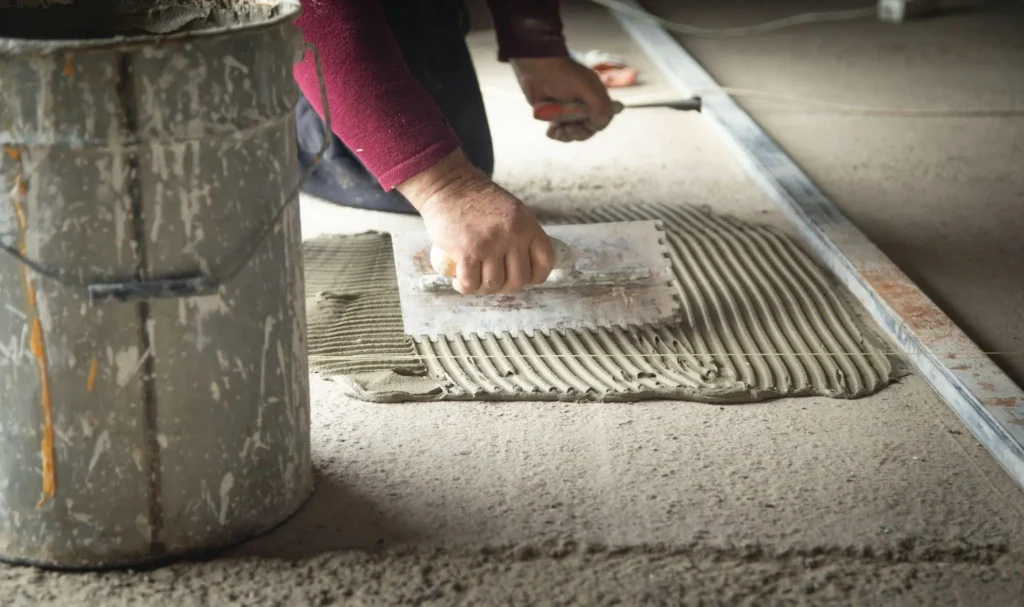
When to Hire Professional Floor Laying Contractors
In-house maintenance teams handle a lot. Floor system replacement in an active industrial facility is one area where the scope regularly exceeds what in-house resources are equipped to manage safely and effectively.
Professional floor laying contractors are the right call when:
- The facility is active during installation. Scheduling around production, managing cure windows, and sequencing around live operations requires planning expertise most maintenance teams aren’t set up for.
- Moisture testing and substrate preparation are required. Surface prep is where most floor failures originate. Shot blasting, grinding, moisture vapor testing, and concrete profiling require equipment and trained technicians.
- Slip resistance has to be balanced with cleanability. In food processing, pharma, and similar regulated environments, getting that balance wrong creates new compliance problems.
- The floor supports heavy equipment or high wheel loads. System selection and installation technique both affect long-term load performance. This is not a DIY specification decision.
- Drainage, coving, transitions, or striping need redesign. These are not add-ons; they’re part of the system. Contractors who understand how they interact with the coating choice produce better results.
- Documentation matters. Warranties, manufacturer-approved installation records, and safety documentation are harder to produce without professional contractors involved from the start.
Related reading: Anti-Slip and Safety Striping Solutions for Warehouses and Industrial Facilities
What Professional Floor Laying Contractors Evaluate Before Replacement
A qualified contractor’s site assessment covers more than square footage. Before recommending a system, expect them to evaluate:
- Traffic patterns and peak load requirements
- Wet, oily, chemical, or thermal exposure
- Existing substrate condition and moisture vapor emission rates
- Drain placement and current slope performance
- Pedestrian and vehicle movement zones
- Cure times, phasing options, and return-to-service windows
- Whether the environment requires slip resistance, seamless sanitary surfaces, or thermal-shock performance
Any contractor who skips this evaluation and leads with a product recommendation is working backward. System selection follows site conditions, not the other way around.
Which Flooring System Fits Which Compliance Problem
Epoxy and Urethane Coatings for General Industrial Use
Epoxy and urethane floor systems are the workhorses of industrial flooring. They perform well under heavy traffic, resist a broad range of chemicals, and clean easily. For general manufacturing, warehousing, and light-to-medium industrial environments, these systems offer durable surface protection with straightforward maintenance.
Urethane Cement for Wet Areas, Hot Washdowns, and Extreme Conditions
Urethane cement is built for environments where standard coatings fail: food processing, pharmaceutical production, dairy operations, and anywhere that sees steam cleaning, hot water washdowns, or rapid thermal cycling. It bonds directly to concrete, resists thermal shock, and produces a seamless, nonporous surface that supports aggressive sanitation protocols. If your floor fails repeatedly near washdown stations or drains, urethane cement is usually the right system to evaluate.
Anti-Slip Finishes for Wet or High-Traffic Walkways
For ramps, entries, production walkways, and transition zones, anti-slip finishes address traction without sacrificing cleanability. In regulated environments, traction coatings need to be specified carefully so that the texture profile doesn’t compromise sanitation requirements.
Safety Striping and Traffic Markings After Replacement
Floor replacement creates an opportunity to reset the entire traffic management system. Pedestrian lanes, forklift corridors, hazard zones, and keep-clear areas can all be rethought as part of the installation rather than painted over an existing layout that may no longer reflect how the facility operates.
Questions to Ask Before Hiring Floor Laying Contractors
Use this list before signing any contract:
- Have you completed projects in facilities like ours, with similar operational constraints?
- What is your process for moisture testing and substrate preparation?
- What safety certifications, insurance, and training do your crews carry?
- Can you phase the project to reduce downtime or work around our production schedule?
- What warranties cover both workmanship and materials?
- How do you handle striping, drains, joints, and transitions as part of the installation?
- Can you provide references or documented project examples from comparable facilities?
- What documentation will we receive for safety records, maintenance guidance, and future audits?
Answers to these questions tell you more about a contractor’s fit than their price point. A crew that can’t answer the substrate prep question in detail has probably skipped it on past jobs.
Why Peckham Coatings Fits Compliance-Driven Replacement Work
Peckham Coatings is a fifth-generation industrial coatings contractor with over a century of experience installing floor systems in demanding environments. Our crews work in food processing facilities, pharmaceutical plants, aerospace facilities, manufacturing operations, dairies, and distribution centers.
What that means practically:
- We plan installations around your production schedule, not the other way around
- Our technicians handle moisture testing, substrate prep, and system selection as part of every project
- We install epoxy and urethane coatings, urethane cement, anti-slip systems, and safety striping
- We provide the documentation facilities need for compliance records and audits
If you’re dealing with recurring floor failures and you’re not sure whether repair or replacement is the right move, a site evaluation is the right starting point.
Frequently Asked Questions
What OSHA standard applies to industrial flooring? The primary standard is 29 CFR 1910.22, which covers walking-working surfaces including floors. 29 CFR 1910.176 adds requirements for marked aisles and passageways in areas where mechanical equipment operates. 29 CFR 1910.144 covers safety color coding for hazard identification.
How do I know when industrial floor repair is no longer enough? Recurring failures in the same location, widespread delamination, persistent pooling water, substrate deterioration, and rising incident reports tied to specific floor zones are the clearest indicators. When the cost of repeated downtime and repairs approaches the cost of replacement, the case for replacement is usually stronger than it appears.
Do OSHA rules require slip-resistant industrial floors? OSHA requires that walking-working surfaces be maintained in a safe condition, kept dry where feasible, and provided with drainage where wet processes are used. Slip-resistant systems are widely used to support those conditions in wet, oily, or high-traffic zones, but OSHA does not mandate a specific floor texture or product.
When should I hire professional floor laying contractors instead of my maintenance team? When the project involves substrate preparation, moisture testing, regulated environments, heavy load zones, or production scheduling around active operations, professional contractors are the right call. The risk of a failed installation in those conditions exceeds the cost savings of in-house work.
What is the best industrial flooring replacement for wet or washdown areas? Urethane cement systems are purpose-built for hot washdowns, wet-process areas, and thermal cycling. They bond directly to concrete, produce a seamless surface, and hold up where standard epoxy coatings fail.
Can industrial flooring replacement be phased to avoid a full facility shutdown? Yes. Experienced contractors design phased installation plans that work around active production. Cure windows, section sequencing, and return-to-service timing are all part of the planning process.
Can damaged sections be repaired without replacing the entire floor? In cases where damage is isolated and the substrate is sound, yes. When failures are recurring, widespread, or tied to substrate or drainage conditions, sectional repair typically doesn’t resolve the underlying problem.
What should I ask floor laying contractors before signing a contract? Experience in comparable facilities, moisture testing and prep process, warranty coverage, insurance and certifications, phasing options, documentation, and the ability to provide references are the most important areas to cover.
Does floor striping need to be redone after replacement? In most cases, yes. Replacement is also an opportunity to update traffic lane layouts, hazard zone designations, and pedestrian/forklift separation to reflect how the facility currently operates.
How often should industrial floors be inspected for compliance risk? OSHA requires regular inspection and correction of hazards before floors return to service. Most facilities establish quarterly or annual inspection schedules, with more frequent reviews in high-traffic or wet-process zones.