What Is FDA Compliant Flooring? A Guide to FDA Approved Epoxy and Polyurethane Systems
- Peckham Coatings Team
If you manage a food processing facility, commercial kitchen, or pharmaceutical plant, the floor beneath your feet is doing more than just holding equipment. It is a direct factor in whether your operation passes inspection, maintains sanitation standards, and avoids costly shutdowns.
FDA-compliant flooring refers to floor coating systems formulated and installed to meet the material safety standards set by the U.S. Food and Drug Administration for surfaces that come into incidental contact with food or that exist within food-safe environments. Not every epoxy or polyurethane system qualifies. The formulation, the surface preparation, and the installation method all matter.
This guide breaks down exactly what makes a flooring system FDA compliant, how epoxy and polyurethane systems differ in regulated environments, and how to choose the right system for your facility.
What Does FDA Compliant Flooring Actually Mean?
FDA-compliant flooring is any floor coating system that meets the material composition standards outlined under 21 CFR 175.300, the section of the Code of Federal Regulations governing resinous and polymeric coatings used on surfaces that may contact food.
To qualify under this regulation, a coating must:
- Be formulated from substances approved for food-contact use
- Not transfer harmful chemicals to food under normal conditions of use
- Maintain a surface that is cleanable, nonporous, and free of cracks or crevices where bacteria can harbor
It is important to understand that the FDA does not certify or approve specific flooring products in the way NSF or USDA does. Instead, compliance is based on whether the coating’s component ingredients appear on the approved substances list within 21 CFR 175.300. This distinction matters when you are evaluating contractor claims or product data sheets. A coating cannot be “FDA certified” in a formal certification sense. It can, however, be formulated to comply with FDA regulations.
Facilities operating under FDA oversight, including food and beverage plants, pharmaceutical manufacturing facilities, and biotech labs, are expected to demonstrate that all surfaces in food-contact or food-adjacent zones meet these standards.
Why Your Floor System Is a Compliance Risk
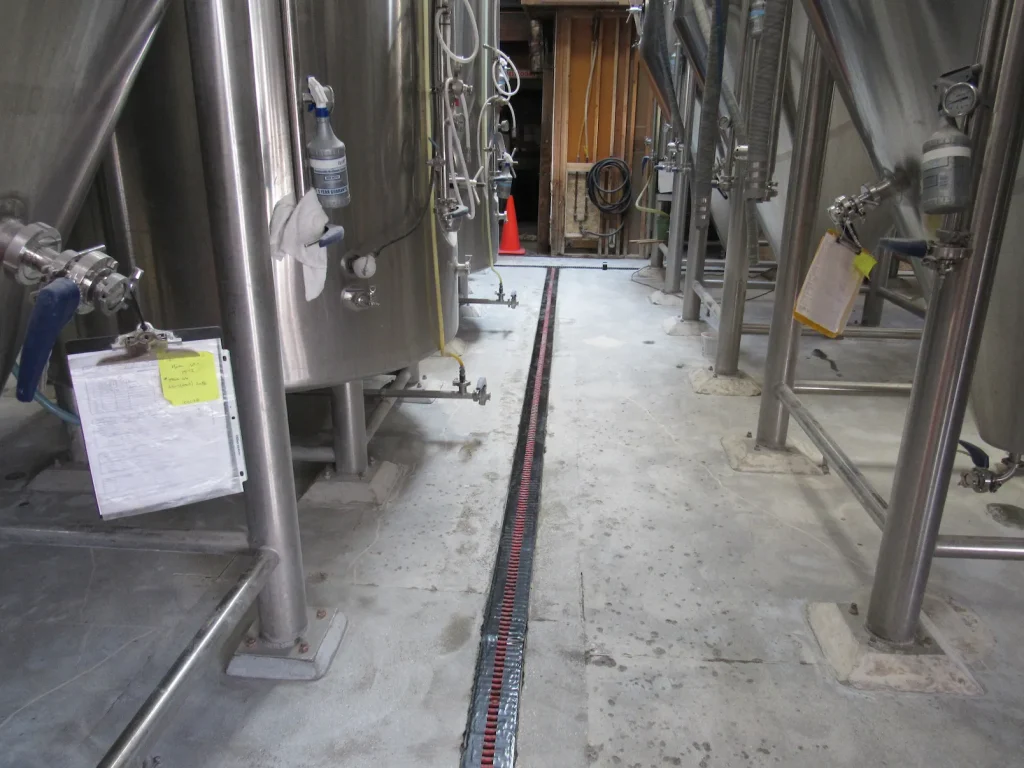
Floors in food processing and pharmaceutical environments are exposed to a combination of stresses that most standard coatings are not engineered to handle. Hot water washdowns, chemical cleaning agents, thermal shock from cold storage to production areas, heavy forklift traffic, and constant moisture all work together to break down inadequate floor systems over time.
When a floor coating fails, the consequences go beyond repair costs. Cracks and delamination create harborage points for bacteria, mold, and other pathogens. A failed floor in a USDA- or FDA-regulated facility can trigger a Form 483 observation, a warning letter, or worse, a forced shutdown during inspection.
Common floor failure modes in regulated facilities include:
- Delamination caused by moisture vapor transmission through the concrete substrate
- Thermal shock cracking from rapid temperature swings between production and washdown cycles
- Chemical degradation from repeated exposure to caustic cleaning agents
- Surface porosity that develops over time as the coating wears thin
Choosing an FDA compliant system is not just about meeting the letter of the regulation. It is about installing a floor that holds up under the conditions that actually exist in your facility, so compliance is maintained long after installation day.
FDA-Approved Epoxy Flooring: What It Is and Where It Works
Epoxy flooring systems are among the most widely specified options in food and pharmaceutical facilities. A properly formulated, FDA approved epoxy system creates a seamless, nonporous surface that resists chemical penetration and can be cleaned and sanitized repeatedly without degrading.
Under 21 CFR 175.300, epoxy formulations may comply with FDA standards when the resin and curing agent components are drawn from the approved substances list. When evaluating an epoxy system for a regulated environment, you should request the product’s formulation data or a letter of compliance from the manufacturer confirming FDA suitability.
FDA-approved epoxy flooring is well-suited for:
- Dry and semi-dry food production areas
- Pharmaceutical and biotech manufacturing floors
- Clean rooms and controlled environments
- Packaging areas with moderate chemical exposure
- Warehousing and distribution facilities under FDA oversight
One performance consideration specific to food environments is thermal shock resistance. Standard epoxy systems can crack when floors shift rapidly between hot washdown temperatures and cold production temperatures. For facilities with severe thermal cycling, a fiber-reinforced epoxy system adds tensile strength and helps the coating flex with the substrate rather than crack against it. Think of it the way rebar reinforces concrete: the fiberglass does not change what the system looks like, but it dramatically changes how the system performs under stress.
Another consideration is moisture. Epoxy bonds well to properly prepared, dry concrete. In facilities where moisture vapor transmission is a concern, a moisture mitigation primer installed before the epoxy system addresses this before it becomes a delamination problem.
FDA-Approved Polyurethane Flooring: When You Need More
For facilities dealing with the harshest conditions, FDA approved polyurethane flooring and urethane cement systems are often the more appropriate specification.
Urethane cement, also known as polyurethane concrete, is a hybrid system that combines Portland cement with urethane resin to create a floor with exceptional resistance to thermal shock, chemical exposure, and moisture. Unlike standard epoxy, urethane cement can be installed over concrete as new as seven days old, and it bonds to damp substrates where epoxy would fail.
FDA-approved polyurethane systems are the preferred choice for:
- Meat and poultry processing plants
- Dairy and cheese production facilities
- Beverage manufacturing with frequent hot washdowns
- Commercial kitchens with steam cleaning protocols
- Any environment with floor drains and standing water cycles
The thermal shock resistance of urethane cement is particularly significant. These systems are engineered to withstand temperature swings from near-freezing to hot steam without cracking or debonding. For a facility running three washdown cycles a day, that performance characteristic is not a minor spec note. It is the difference between a floor that lasts a decade and one that requires remediation within two years.
From a regulatory standpoint, polyurethane coatings intended for food-adjacent surfaces should also comply with 21 CFR 175.300. As with epoxy systems, confirm compliance through product documentation rather than marketing language alone.
Epoxy vs. Polyurethane: Choosing the Right FDA Compliant System
Both epoxy and polyurethane systems can meet FDA compliance requirements. The right choice depends on the specific conditions in your facility.
| Factor | FDA-Approved Epoxy | FDA-Approved Polyurethane/Urethane Cement |
| Thermal shock resistance | Moderate (improved with fiber reinforcement) | Excellent |
| Chemical resistance | Good to excellent | Excellent |
| Moisture tolerance | Requires dry substrate | Bonds to damp concrete |
| Installation on new concrete | Requires cured concrete | Can be install on 7-day-old concrete |
| Best for | Dry production, pharma, clean rooms | Wet processing, dairy, meat, beverage |
| Surface profile | High-gloss, seamless | Matte to satin, seamless |
| Typical thickness | 1/8″ to 3/16″ | 1/4″ to 3/8″ |
When thermal shock is not a major factor and the environment is relatively dry, a high-quality epoxy system is a cost-effective and durable choice. When the facility involves frequent hot washdowns, steam, chemical cycling, or drainage, urethane cement is the more reliable long-term investment.
In facilities with mixed zones, the right answer is often both: urethane cement in production and washdown areas and epoxy in packaging, warehousing, or office-adjacent zones. A thorough site evaluation before specification is the only way to get this right.
What the Installation Process Looks Like
Even a properly formulated FDA compliant floor coating will fail if the installation process is wrong. Surface preparation is the most critical variable in whether a floor system performs as specified.
A properly executed installation follows this sequence:
- Substrate assessment: Evaluate concrete condition, moisture vapor emission rate (MVER), surface profile, and existing coating adhesion.
- Surface preparation: Diamond grinding or shot blasting to achieve the correct surface profile (typically ICRI CSP 3 to CSP 5) for the specified coating system.
- Moisture mitigation (if required): Application of a moisture vapor barrier primer when MVER exceeds the coating manufacturer’s threshold.
- Base coat application: Installation of the primer or base coat in the specified thickness and coverage rate.
- Broadcast or intermediate layers: Application of aggregate broadcast, quartz, or intermediate coat for texture, slip resistance, and build.
- Top coat application: Sealer or top coat applied to achieve the final surface profile, chemical resistance, and cleanability.
- Cure time management: Allowing appropriate cure time before traffic and cleaning protocols begin.
For regulated facilities, proper documentation of the installation process, including product data sheets, batch numbers, and installer certifications, is worth maintaining as part of your facility’s compliance records.

Working With a Contractor Who Understands Regulated Environments
Specifying the right flooring system is only part of the equation. The contractor installing it needs to understand the operational realities of a regulated facility: the importance of scheduling around production windows, the documentation requirements that support compliance records, and the technical nuances of installation in environments where cutting corners has real consequences.
At Peckham Coatings, we have been installing high-performance floor systems in food processing, pharmaceutical, and industrial facilities for over a century. We work only with manufacturers whose products carry documented compliance with FDA regulations, and we schedule every installation around your operation so downtime is planned, not forced.
If you are evaluating FDA compliant flooring for a food processing or pharmaceutical facility, the right specification starts with understanding your environment, washdown procedures, and moisture conditions.
Our team can assess your facility and recommend the right epoxy or urethane system for long-term compliance and durability.
Contact us and request a technical consultation today.
Frequently Asked Questions About FDA Compliant Flooring
Is there such a thing as FDA certified flooring? No. The FDA does not operate a product certification program for flooring. Compliance is based on whether a coating’s ingredients conform to the approved substances listed in 21 CFR 175.300. Manufacturers can produce documentation supporting compliance, but no government-issued certificate exists.
What is the difference between FDA compliant and USDA compliant flooring? Both address food safety, but through different regulatory frameworks. USDA compliance is governed by USDA facility requirements for meat, poultry, and egg processing plants. FDA compliance applies to the broader range of food, beverage, dietary supplement, and pharmaceutical facilities regulated under the FDA. Many facilities need to satisfy both, and most quality urethane cement and epoxy systems can be formulated to address both sets of requirements simultaneously.
Can I install FDA compliant flooring over my existing floor? In some cases, yes. The condition of the existing coating and the underlying concrete determines whether an overlay is viable. If the existing coating is delaminating, cracked, or contaminated, removal is the safer path. A site evaluation will determine the best approach for your specific situation.
How long does an FDA compliant floor coating last? A properly specified and installed system in a food processing environment typically lasts 7 to 15 years, depending on traffic intensity, chemical exposure, and maintenance practices. Urethane cement systems in high-demand environments tend to outperform epoxy on longevity when thermal and moisture stresses are significant.How do I verify that a coating system is FDA compliant? Request the manufacturer’s 21 CFR 175.300 compliance documentation or a letter of conformance. Any reputable manufacturer of food-grade flooring will have this documentation available. Your coating contractor should be able to provide this as part of the project specification package.
Share this article :
Steven Peckham
We’re always happy to answer any of your questions.