What does industrial epoxy flooring cost per square foot in 2026?
Industrial epoxy flooring costs $4 to $18 per square foot installed in 2026, with most commercial projects landing between $5 and $12 per square foot. The 4× range comes down to four variables: the system you specify, the condition of your existing slab, total project square footage, and how aggressive your operating environment is — thermal cycling, chemical exposure, washdown frequency, and any mil-spec or USDA/FDA requirements you have to meet.
A per-square-foot price is only useful when you know what's inside it. A turnkey industrial coatings number should include surface prep (diamond grinding or shotblasting to the correct concrete surface profile), primer, basecoat, broadcast aggregate where applicable, topcoat, basic crack and joint detailing, on-site mobilization, dust containment, and a written warranty. It typically does not include moisture mitigation primers if your slab tests above the system's MVT tolerance, full coating removal of an existing failed floor, structural concrete repair beyond minor crack chasing, or expedited overnight/weekend premiums.
Over 25 years installing industrial floors across California, Oregon, Washington, Nevada, Utah, Arizona, Idaho, and Montana, we've seen the same building get four legitimately different bids — all defensible — because each contractor priced a different system, prep level, and schedule assumption. This guide breaks down exactly where the dollars go so you can compare apples to apples and budget within ±10% before a single contractor walks the floor.
Industrial epoxy cost by system type
System chemistry is the single biggest driver of the per-square-foot number. A 20-mil thin-film epoxy and a 1/4-inch trowel-down urethane cement are both 'epoxy floors' in casual conversation, but they're 4× apart on price and engineered for completely different service conditions. Here's a realistic 2026 budgeting range for the most common industrial systems we install — turnkey, prep-included, single-mobilization numbers, not material-only.
| System | Thickness | Typical use | 2026 range ($/sf) |
|---|---|---|---|
| Thin-mil epoxy (2-coat) | 20 mil | Warehouse, dry storage, light traffic | $4.00 – $5.50 |
| Self-leveling epoxy | 40 – 60 mil | Manufacturing, assembly, light forklift | $5.50 – $8.00 |
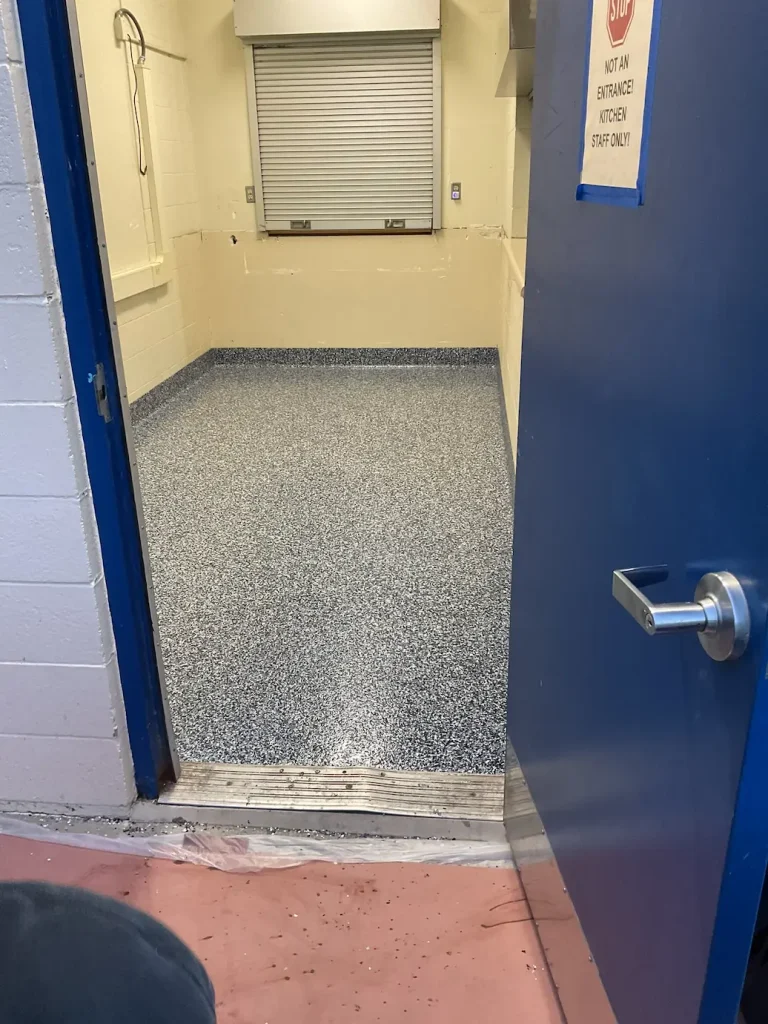
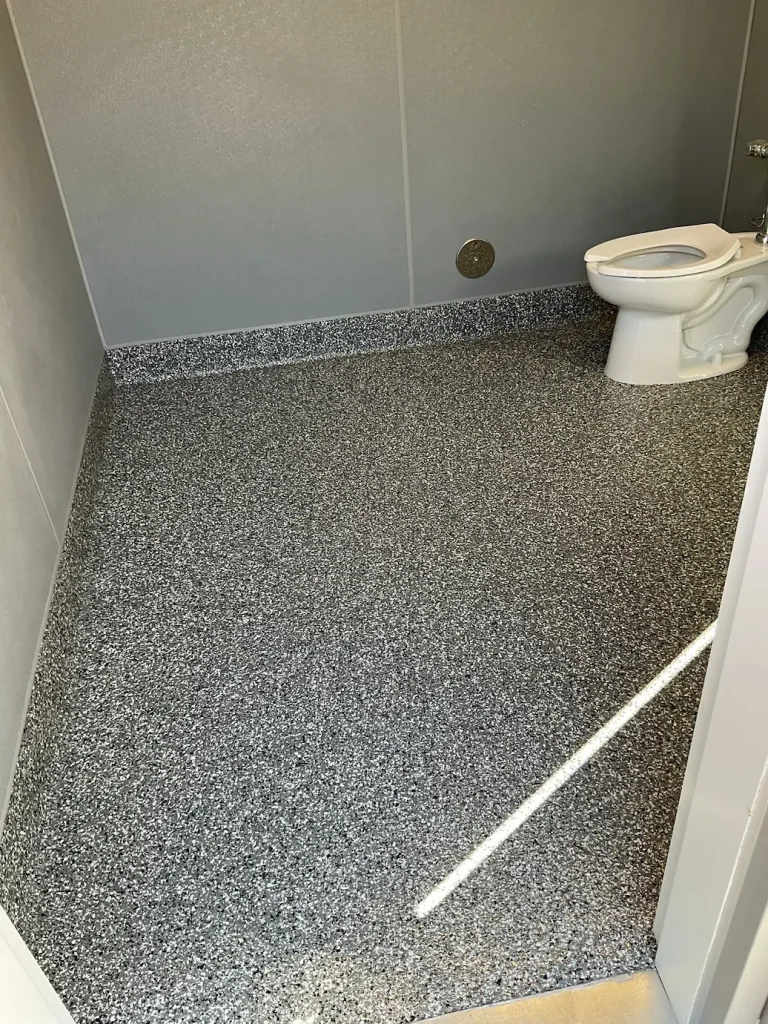
| Decorative flake / quartz broadcast | 60 – 80 mil | Showrooms, locker rooms, retail, schools | $7.00 – $10.00 |
| High-build double-broadcast quartz | 100 – 125 mil | Commercial kitchens, heavy traffic | $9.00 – $12.00 |
| Urethane cement slurry | 3/16″ (≈190 mil) | Dairies, breweries, wet processing | $10.00 – $14.00 |
| Urethane cement trowel-down | 1/4″+ (≈250 mil) | Meat plants, hot wash, thermal cycling | $13.00 – $18.00 |
| MMA (fast-cure methyl methacrylate) | 60 – 100 mil | 4-hour return-to-service, cold storage | $11.00 – $16.00 |
When thin-mil epoxy makes sense
Thin-mil systems are the right answer when your floor is dry, climate-controlled, and the slab is in good condition. They install in a single day on most warehouse spaces, return-to-service in 24 hours, and look great for 5–7 years with normal cleaning. They are the wrong answer the moment forklift wheels start chunking through them or moisture vapor starts pushing up from below — at which point you're paying twice.
When urethane cement is non-negotiable
If your facility sees daily caustic washdown, steam cleaning, hot oil, or thermal shock from cold-room to wash-bay cycling, urethane cement is the only system that survives. The thermal expansion coefficient nearly matches concrete, which is why the floor doesn't crack when 180°F wash water hits a 40°F slab. It costs 2–3× a thin-film epoxy, but it's also the last floor a meat plant or dairy needs to install for 15+ years.
Cost by surface prep level
Surface preparation is 25–40% of an industrial coating line item, and it's the single line bidders cut to win on price. The International Concrete Repair Institute defines nine concrete surface profiles (CSP-1 through CSP-9). Industrial epoxy systems require CSP-2 through CSP-5 depending on system thickness — and the wrong profile is the #1 cause of delamination failures we get called in to fix.
The table below is what proper prep adds on top of the base system cost. If a bid doesn't itemize prep, ask the contractor to break it out — you need to know whether you're getting a CSP-2 acid wash (almost never appropriate for industrial work) or a CSP-4 shotblast that will actually hold the coating.
| Prep level | Method | When required | Added $/sf |
|---|---|---|---|
| CSP-2 / CSP-3 | Diamond grinding (single-head) | Thin-mil epoxy on clean, sound slab | $0.75 – $1.50 |
| CSP-3 / CSP-4 | Diamond grinding (planetary, multi-head) | Self-leveling epoxy, decorative systems | $1.25 – $2.50 |
| CSP-4 / CSP-5 | Shotblasting | High-build, urethane cement, mortar systems | $1.75 – $3.50 |
| Full coating removal | Shotblast + grind + scarify | Existing failed coating, paint, sealer | $2.50 – $6.00 |
Why cheap bids cut prep first
We've been called out to repair plenty of $3.50/sf 'epoxy floor' jobs that failed within 18 months. The savings disappeared the first time the line went down and the plant had to mobilize a new contractor on an emergency schedule. Cheap bids almost always quote CSP-2 acid etch or a quick single-head grind on a slab that needs full planetary grinding or shotblasting. The coating goes down, looks fine for six months, then disbonds in sheets at the first thermal cycle or aggressive cleaning pass.
Cost by project size
Per-square-foot pricing is heavily size-dependent because the fixed costs of an industrial coatings mobilization — crew lodging, equipment trucking, dust containment setup, on-site QA, project management — are roughly the same whether you coat 2,500 sf or 25,000 sf. The result is a steep premium on small jobs and meaningful economy of scale above 20,000 sf.
| Project size | Mobilization impact | Typical $/sf adjustment | Notes |
|---|---|---|---|
| Under 2,500 sf | Fixed costs dominate | +30% to +60% | Often below our crew minimum — we'll usually decline. |
| 2,500 – 7,500 sf | Heavy mobilization weight | +15% to +30% | Most single-room or small-facility projects. |
| 7,500 – 20,000 sf | Balanced — typical baseline | Baseline pricing | Our quoted ranges in this guide use this size. |
| 20,000 – 60,000 sf | Mobilization amortizes | -5% to -12% | Better unit pricing; phased install possible. |
| 60,000+ sf | Multi-mobilization, phased | -10% to -18% | Multi-week schedule, dedicated crew. |
Cost variation by state
Industrial epoxy pricing varies meaningfully across the Western U.S. because of three factors: prevailing-wage rules on commercial and public projects (California is the dominant outlier), VOC and air-quality regulation (CARB in California, similar in parts of Oregon and Washington), and mobilization distance to your site. The table below reflects what we typically quote for a 10,000-sf industrial project at standard 60-mil decorative spec, including prep and mobilization.
California projects routinely run 15–25% higher than equivalent specs in Nevada or Utah, primarily because of prevailing-wage requirements on public and qualifying commercial work, and because CARB-compliant low-VOC resin systems cost more than standard chemistry. Conversely, projects in remote Idaho, Montana, or Eastern Oregon include a per-diem and trucking premium that can add $1–$3/sf depending on the distance from our nearest crew.
| State | Typical range ($/sf) | Key cost driver |
|---|---|---|
| California | $8.50 – $13.00 | Prevailing wage on public/commercial, CARB-compliant low-VOC chemistry |
| Oregon | $7.50 – $11.50 | Higher urban labor in Portland; rural mobilization elsewhere |
| Washington | $8.00 – $12.00 | Urban labor pricing in Puget Sound; longer drives east of the Cascades |
| Nevada | $7.00 – $10.50 | Competitive Las Vegas/Reno markets; tighter pricing on volume |
| Utah | $6.75 – $10.00 | Strong Wasatch Front competition; standard mobilization |
| Arizona | $7.00 – $10.50 | Phoenix labor rates moderate; summer scheduling premiums |
| Idaho | $7.50 – $11.50 | Mobilization premium from Treasure Valley to remote sites |
| Montana | $8.50 – $13.50 | Longest mobilization distances; smaller contractor pool |
Factors that drive cost up or down
Beyond the system, prep, size, and state, five service-condition factors meaningfully move the per-square-foot number. Knowing which apply to your facility lets you budget realistically before the RFQ goes out.
Thermal cycling and hot washdown
If your facility sees water above 140°F — hot CIP cycles, steam cleaning, hot oil spills, kettle areas — standard epoxy will eventually crack or delaminate because its thermal expansion coefficient is ~3× that of concrete. Urethane cement is the answer, and it typically adds $4–$7/sf over a comparable thin-film epoxy. The upgrade is non-optional for breweries, dairies, meat processing, commissary kitchens, and any rinse-down food plant. Specifying epoxy in those environments is the most expensive mistake on this list.
Chemical exposure
Topcoat chemistry is matched to the chemicals your floor will see. A standard aliphatic urethane topcoat handles routine sanitizers, light hydrocarbons, and detergents. Move into concentrated acids (battery rooms, plating, certain food acids), strong solvents, or aggressive caustics and you need a novolac epoxy or vinyl ester topcoat — typically $1.50–$3.50/sf above standard. Provide your contractor the SDSs for everything that will hit the floor; matching chemistry up front is dramatically cheaper than recoating after a chemical failure.
Mil-spec and federal-spec requirements
Military and federal projects (Navy, Air Force, GSA, USACE, DOE) frequently specify floor systems under MIL-PRF-32171, MIL-DTL-24441, or UFGS 09 67 23. Compliance requires specific manufacturers, documented installer qualifications, third-party QA, and often holiday testing on the cured film. The spec premium typically runs $2–$5/sf over a comparable commercial system — driven mostly by QA documentation, submittals, and the slower, witnessed install pace, not the materials themselves.
USDA/FDA compliance and integral cove base
Food contact zones require coved transitions where the floor meets the wall, sealed penetrations around drains and equipment, and a topcoat approved for incidental food contact. Integral 4″–6″ cove base adds $8–$15 per linear foot of wall — on a 10,000-sf room with 400 lf of perimeter, that's another $3,200–$6,000. USDA-compliant cove and drain detailing is one of the more frequently under-bid line items; it's worth asking specifically how it's priced.
Schedule and shutdown windows
Working second shift, overnight, weekends, or in a tight production-shutdown window adds 15–40% to a project. The most extreme example is fast-cure MMA in an active cold storage facility — 4-hour return-to-service, no production interruption, and a 30–50% premium over an equivalent epoxy install. If you can give the contractor a full week of dedicated access, you'll pay the low end of every range in this guide.
Common spec mistakes that inflate the bid
Over the past 25 years we've seen the same handful of spec errors push bids 20–40% higher than they need to be — or worse, lock in a system that fails inside two years. The fix in every case is a tighter pre-RFQ scope.
- ›Over-speccing thickness — calling for 1/4″ urethane cement in a dry warehouse where a 40-mil self-leveling epoxy would last 15 years.
- ›Missing moisture mitigation budget — failing to test MVT before bidding, then absorbing a $20,000–$50,000 change order mid-install.
- ›No allowance for crack and joint repair — every linear foot of structural crack adds $4–$12 of detail work; assume 10–20% of slab area needs attention on slabs over 15 years old.
- ›Wrong topcoat chemistry — specifying a standard aliphatic where a novolac is required, then recoating in 18 months at full price.
- ›Vague shutdown scope — leaving the contractor to assume normal hours when the facility actually needs night/weekend work, then issuing a 30% change order.
- ›Comparing material-only bids to turnkey bids — apples-to-oranges across contractors is the most common reason owners feel like they got bait-and-switched.
How to get an accurate quote
A real industrial coatings contractor will walk your floor, run moisture testing where the system requires it, and give you a line-item proposal that itemizes prep, primer, basecoat, broadcast, topcoat, coving, mobilization, and warranty terms separately. If you're collecting bids, send every contractor the same package below so you can compare on identical assumptions.
With that package in hand, any qualified contractor can give you a budget range within one business day and a fixed-price spec after a site walk. We provide free walk-throughs across our Western U.S. service area — California, Oregon, Washington, Nevada, Utah, Arizona, Idaho, and Montana.
- ›Slab age, square footage, and a sketch of the area (rooms, drains, equipment pads).
- ›10–15 photos: overall room, slab close-ups, existing coating condition, drains, wall transitions, any failed or damaged areas.
- ›Service conditions: traffic type (forklift class, foot, cart), chemicals on the floor (with SDSs if available), max water temperature, washdown frequency.
- ›Any compliance requirements: USDA/FDA, mil-spec, CARB, prevailing wage, project-labor agreements.
- ›Shutdown window: how many continuous days/hours we have access, and whether the area must return to service inside that window.
- ›Target start date and any hard deadlines (audit, inspection, lease deadline).
Related Peckham services
Frequently asked cost questions
The most common cost questions we get from facility managers, GCs, and plant engineers across the Western U.S.
What's the cheapest viable industrial epoxy system?
A 20-mil two-coat thin-film epoxy at $4.00–$5.50/sf installed is the entry point for industrial work. Below that price, you're either getting a residential-grade kit applied by a non-specialist, or a contractor cutting prep that will fail inside two years. The cheapest viable spec for a clean, dry warehouse floor is roughly $4.50/sf turnkey — anything materially below that should be scrutinized line-by-line.
How much more does urethane cement cost vs epoxy?
Urethane cement runs $4–$7/sf more than a comparable epoxy install — $10–$18/sf vs $4–$12/sf — for two reasons: the binder chemistry is roughly 2× the material cost, and the trowel-down install is more labor-intensive than a roller-applied epoxy. The premium is non-optional in wet-process, thermal-cycling environments where standard epoxy will fail.
How much does surface prep add to the bid?
Surface prep is typically 25–40% of an industrial coatings line item. In dollar terms, expect $0.75–$1.50/sf for thin-mil systems on sound slabs, $1.25–$2.50/sf for shotblast prep on most decorative and high-build systems, and $2.50–$6.00/sf if an existing failed coating needs to be mechanically removed. Moisture mitigation primers add another $1.50–$3.50/sf when required.
Do I actually need MMA fast-cure, or is it overkill?
MMA is justified only when downtime cost exceeds the install premium. Typical use cases: an active cold storage facility that can't shut down, an emergency repair on a 24/7 production line, or a winter install where temperatures rule out standard epoxy cure. The 30–50% premium over equivalent epoxy is real — but a single day of avoided production loss in a beverage plant or distribution center usually pays for the entire upgrade.
What's the typical project minimum for a real industrial contractor?
Our practical minimum is around 2,500 sf, or any project where the system spec justifies a crew mobilization — a small but spec-critical USDA-rated processing room, an ESD-controlled lab, a wastewater containment vault. Below that threshold the fixed costs of mobilization make the per-sf number uneconomic for the owner, and most quality industrial contractors will either decline or charge a flat mobilization fee on top of material.
FAQ
What's the cheapest viable industrial epoxy system?
A 20-mil two-coat thin-film epoxy at $4.00–$5.50 per square foot installed is the entry point for industrial work. Below that price you're either getting a residential-grade kit applied by a non-specialist or a contractor cutting surface prep that will fail within two years. The cheapest defensible spec for a clean, dry warehouse floor is roughly $4.50 per square foot turnkey.
How much more does urethane cement cost than epoxy?
Urethane cement runs $4 to $7 per square foot more than a comparable epoxy install — typically $10 to $18 per square foot versus $4 to $12 per square foot for epoxy. The premium reflects roughly 2× the material cost for the binder and a more labor-intensive trowel-down installation, and it's non-optional in wet-process, thermal-cycling environments where standard epoxy will fail.
How much does surface prep add to an industrial epoxy bid?
Surface preparation is typically 25–40% of an industrial coatings line item. Expect $0.75–$1.50 per square foot for thin-mil systems on sound slabs, $1.25–$2.50 per square foot for shotblast prep on decorative and high-build systems, and $2.50–$6.00 per square foot if an existing failed coating needs to be mechanically removed. Moisture mitigation primers add another $1.50–$3.50 per square foot when slab MVT exceeds the system's tolerance.
Do I actually need MMA fast-cure, or is it overkill?
MMA fast-cure is justified only when downtime cost exceeds the install premium — active cold storage that can't shut down, an emergency repair on a 24/7 production line, or a winter install where temperatures rule out standard epoxy cure. The 30–50% premium over equivalent epoxy is real, but a single day of avoided production loss in a beverage plant or distribution center usually pays for the entire upgrade.
What's the typical project minimum for an industrial epoxy contractor?
Our practical minimum is around 2,500 square feet, or any project where the system spec justifies a crew mobilization — a small but spec-critical USDA-rated processing room, an ESD-controlled lab, or a wastewater containment vault. Below that threshold the fixed costs of mobilization make the per-square-foot number uneconomic for the owner, and most quality industrial contractors will either decline or charge a flat mobilization fee on top of material.