What a crack in an industrial floor is actually telling you
Every concrete floor cracks eventually. The useful question is not whether a crack exists but what caused it and whether it is still moving, because those two answers decide the repair. Filling a moving crack with a rigid material simply relocates the crack a few inches away; sealing a crack that is leaking moisture from below hides a problem instead of fixing it.
In an industrial or commercial facility, cracks also become operational issues before they become structural ones. They collect water and product, they harbor bacteria in food and beverage environments, they chip out under forklift wheels, and they become a trip hazard once the edges spall. That is usually what turns a crack into a work order.
This guide covers how to read a floor crack, what epoxy and polyurethane repair materials actually do, and when repair stops making sense compared with resurfacing the floor.
Crack types and how to tell them apart
Before choosing a material, classify the crack. Most cracks in a commercial slab fall into a handful of categories, and each points to a different fix.
- ›Shrinkage and hairline cracks — narrow, often random or map-like, formed as the slab cured; generally static and cosmetic unless they widen
- ›Structural cracks — wider, sometimes with vertical displacement between the two sides; caused by loading, settlement, or inadequate support
- ›Joint spalling — not really a crack but a broken-down control or construction joint edge, usually from wheel impact on an unfilled or under-filled joint
- ›Moving (active) cracks — any crack that opens and closes with temperature, moisture, or load cycling
- ›Static (dormant) cracks — cracks that have stabilized and no longer change width
How to check whether a crack is still moving
The practical test is time. Monitoring a crack across a temperature and production cycle — or simply checking whether previous rigid repairs in the same slab have re-cracked — tells you more than measuring width once. If earlier patches keep splitting down the middle, the crack is active and needs a flexible treatment or a joint, not another rigid fill.
A crack with vertical offset between the two sides, or one that keeps reappearing after repair, is a structural question first. Coatings and fillers do not add load capacity, and a repair applied over an unresolved structural cause will fail again on the same line.
Epoxy vs. polyurethane crack repair: where each one fits
The two workhorse chemistries for concrete crack repair behave in opposite ways, and that difference is the whole selection logic.
Rigid epoxies cure hard and bond strongly to sound concrete. Injected into a dormant crack, an epoxy can restore load transfer across the crack so the slab behaves closer to monolithic again. That is exactly what you want on a static structural crack — and exactly what you do not want on a crack that is still moving, because a rigid repair stronger than the surrounding concrete forces the next movement to break new concrete alongside it.
Polyurethanes stay flexible. They accommodate movement rather than resisting it, and fast-reacting formulations are commonly used where water is actively seeping through a crack. The trade-off is that a flexible fill does not restore structural continuity — it seals and protects, it does not stitch the slab back together.
| Condition | Typical approach | Why |
|---|---|---|
| Dormant structural crack, no movement | Rigid epoxy injection | Restores load transfer across the crack |
| Active/moving crack | Flexible polyurethane or treat as a joint | Accommodates continued movement without re-cracking |
| Water actively seeping through | Polyurethane | Reacts in the presence of moisture and seals the path |
| Spalled joint edge | Rebuild edge, then semi-rigid joint filler | Supports the wheel-load edge that failed in the first place |
| Wide surface network before coating | Patch/skim and resurface | Individual repairs would telegraph through the finish |
Why crack repairs fail
Most failed crack repairs come down to preparation, not product. A crack full of dust, oil, curing compound, or old sealant gives the repair material nothing sound to bond to, so the repair debonds at the wall of the crack and reopens along the original line.
The other recurring cause is a material mismatch — rigid fill in a moving crack, or a thin surface skim over a crack that runs the full depth of the slab. Both look correct on the day of installation and both reappear within a season.
- ›Open and clean the crack; remove dust, contaminants, and failed previous repairs
- ›Match the material to the movement, not to what is on the shelf
- ›Address moisture and drainage issues before sealing anything
- ›Do not bridge a full-depth crack with a surface-only skim
- ›Resolve the structural cause where one exists — repair is not reinforcement
Control joints are not cracks — and shouldn't be repaired like them
Saw-cut control joints exist to tell the slab where to crack. Filling them rigidly defeats their purpose; leaving them empty in a traffic area lets wheel loads chew out the edges until the joint spalls. The usual answer for a traffic-exposed joint is a semi-rigid filler that supports the edge while still allowing the joint to work, installed after any broken edge has been rebuilt.
In food, beverage, and healthcare environments the joint detail carries a sanitation requirement on top of the mechanical one, since open joints hold water and soil. Those environments generally push toward a coating or floor system that carries a detailed, cleanable joint treatment rather than an exposed saw cut.
Repairing cracks before a coating installation
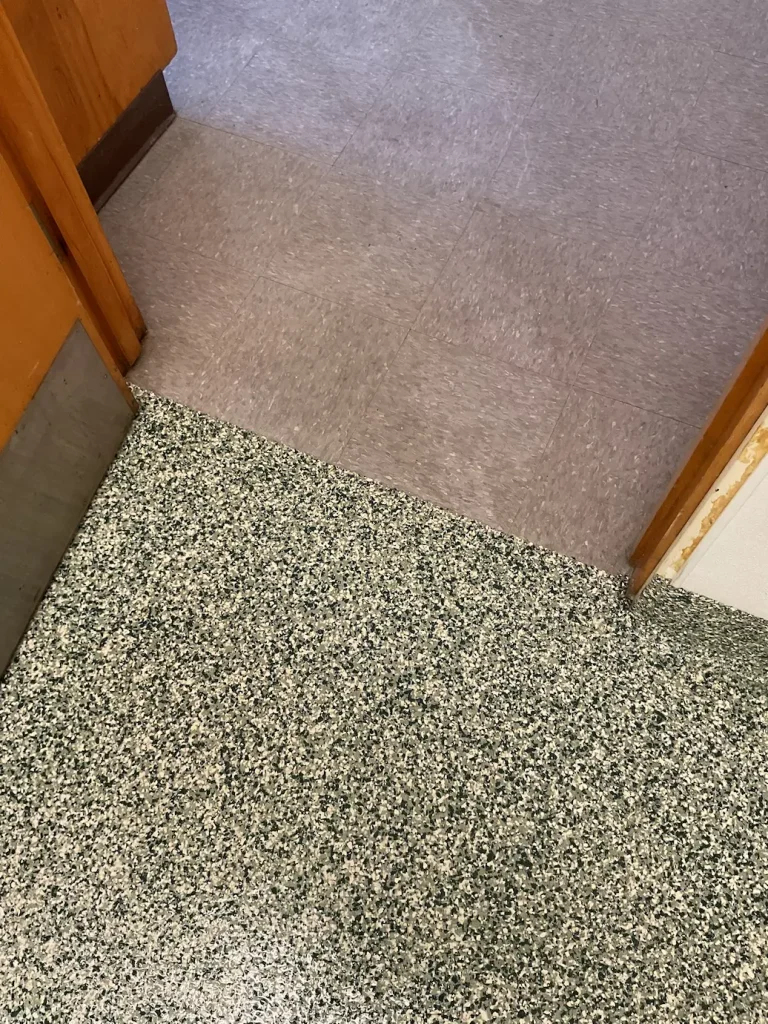
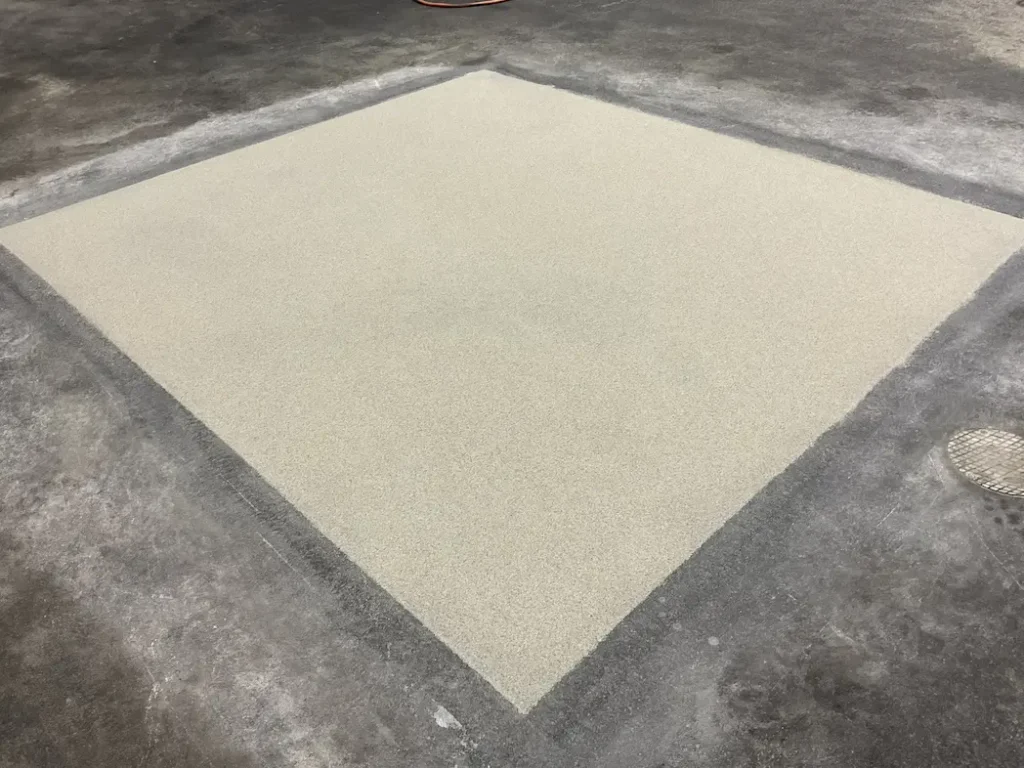
When cracks are being repaired as prep for a new floor, the repair is part of the coating system rather than a standalone fix. Cracks and spalls are opened, cleaned, and filled, the surface is mechanically profiled, and then the floor system goes over the top as a continuous film. Done in that order, the repairs disappear into the finish. Done out of order, they show.
How much crack work a floor needs also affects which system makes sense. A slab with widespread surface deterioration is often better served by a self-leveling or heavier-build system that resurfaces the whole floor, while a sound slab with isolated cracks only needs spot repair before a standard coating. Our epoxy flooring installation process guide walks through where surface prep and repair sit in the overall sequence.
Substrate condition also steers the system choice: epoxy and urethane flooring for general industrial and commercial slabs, urethane cement where thermal shock and wet processing are involved, and polished concrete where the existing slab is sound enough to become the finish itself.
When to repair and when to resurface
Spot repair makes sense when the slab is fundamentally sound and the cracking is isolated, the cause is understood and resolved, and the surrounding surface is still doing its job. At that point, repairing a handful of cracks is the cheaper and faster answer by a wide margin.
Resurfacing becomes the better call when cracking is widespread, when the existing surface is deteriorating alongside the cracks, when the environment demands a continuous cleanable film, or when patch repairs keep coming back. At that point you are paying repeatedly for a symptom. Rebuilding the surface as a system — repairs, profile, and a coating over the whole floor — costs more up front and stops the cycle.
If you are not sure which side of that line your floor sits on, the condition of previous repairs is the best evidence you have. Cracks that have been filled twice and split twice are telling you the answer.
FAQ
Can you just coat over a cracked concrete floor?
Not directly. A coating film follows the substrate, so an unrepaired crack will telegraph through and reopen in the finish. Cracks are opened, cleaned, and filled as part of surface preparation before the coating goes on.
Should I use epoxy or polyurethane to repair a floor crack?
Rigid epoxy suits dormant cracks where you want to restore load transfer across the crack. Flexible polyurethane suits cracks that are still moving or that have water seeping through, because it accommodates movement instead of resisting it.
Why did my floor crack come back after it was repaired?
Usually one of three reasons: the crack was still moving and got a rigid repair, the crack wasn't cleaned out and the repair debonded, or the underlying structural or moisture cause was never addressed.
Are control joints supposed to crack?
Control joints are saw cuts placed to control where the slab cracks, so cracking along them is expected. What needs attention is a joint edge that has spalled or broken down under traffic, which is repaired and filled rather than treated as a random crack.