Introduction
A static discharge of 35 volts is enough to damage a modern semiconductor. The human body cannot detect a static charge below roughly 3,000 volts. That gap, between what electronics can tolerate and what a person can feel, is the problem that electrostatic discharge flooring exists to solve.
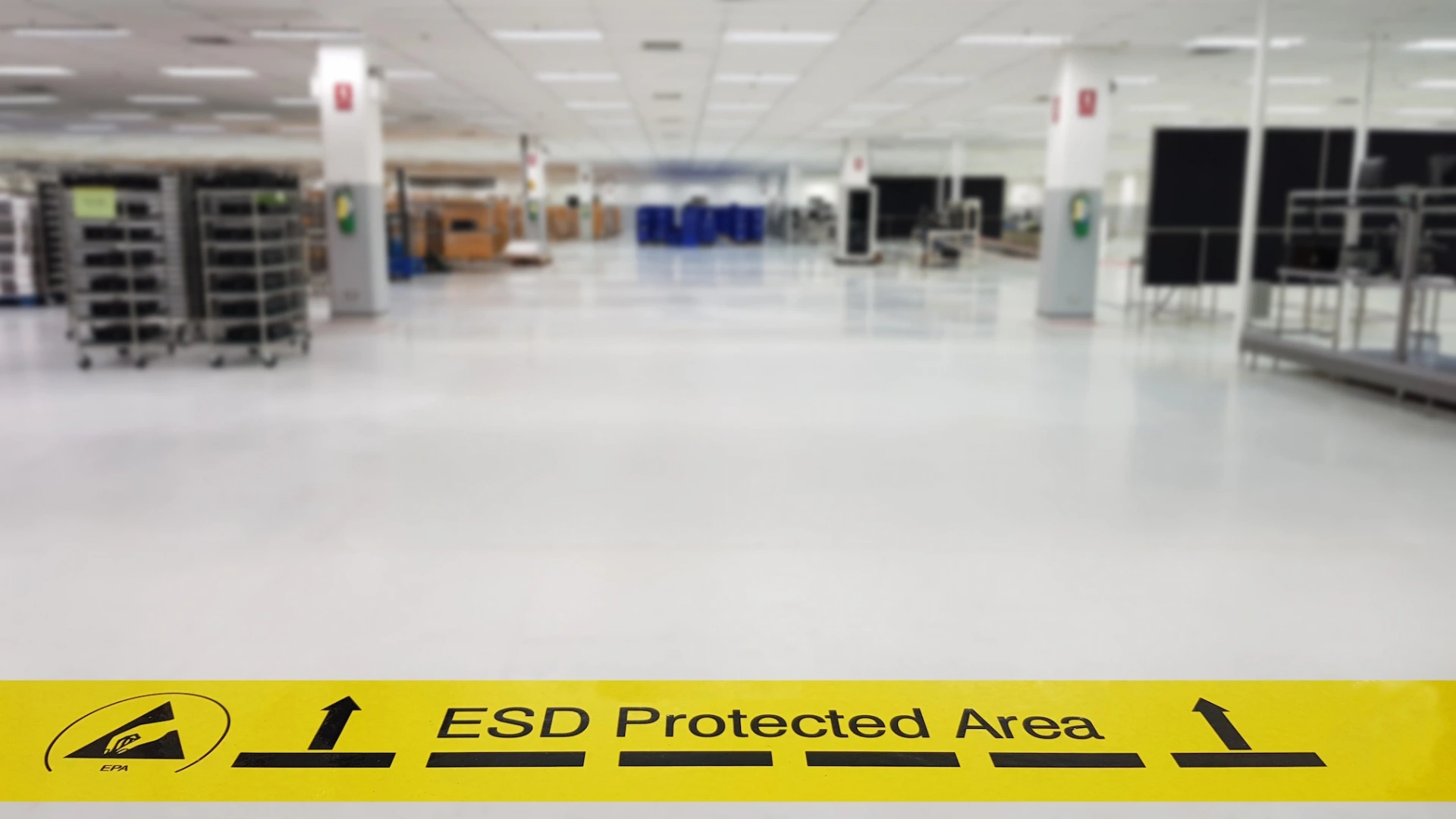
In electronics manufacturing, cleanrooms, pharmaceutical production, aerospace assembly, and data center environments, an uncontrolled electrostatic discharge (ESD) event can destroy a component worth a fraction of a cent or interrupt a system worth millions. The floor is one of the primary mechanisms for controlling static charge buildup in personnel walking through these environments, and it must be specified correctly to perform that function reliably.
This guide covers how ESD flooring systems work, the difference between conductive and dissipative systems, what ANSI/ESD S20.20 actually requires, which industries need it and why, and what correct specification and installation look like.
How Static Charge Builds Up and Why Flooring Matters
Static electricity accumulates through triboelectric charging: the transfer of electrons between surfaces that come into contact and then separate. Every time a person takes a step, their footwear contacts the floor surface and then separates from it. If the floor is electrically insulative, which standard concrete, vinyl tile, and most conventional flooring materials are, the charge that accumulates on the person's body has nowhere to go. It builds with each step until the person touches a grounded object, conductor, or sensitive component, at which point the charge releases instantly as an electrostatic discharge.
The speed and intensity of that discharge are what make it dangerous to electronics. ESD events occur in nanoseconds. The voltage spike that results can exceed the damage threshold of sensitive components even when the person generating it feels nothing at all. Components that survive an ESD event may still sustain latent damage that causes intermittent failure weeks or months later, making ESD damage one of the more difficult quality and reliability problems to trace back to its source.
Electrostatic discharge flooring addresses this by providing a continuous electrical path to ground through the floor surface itself. When the floor is properly conductive or dissipative and personnel are wearing ESD-rated footwear, charge is continuously dissipated to ground rather than accumulating on the body.
Conductive vs. Dissipative: The Core Distinction
The two primary categories of electrostatic discharge flooring are conductive and static dissipative, defined by their electrical resistance to ground. The distinction matters because the right category depends on the environment, the sensitivity of the components or processes involved, and the applicable standard.
| Classification | Resistance to Ground | Typical Application | Key Characteristic |
|---|---|---|---|
| Static conductive | Less than 1.0 x 10⁶ ohms (1 megohm) | Environments with highly sensitive components; explosive atmospheres | Dissipates charge very rapidly; may present shock risk if not properly grounded |
| Static dissipative | 1.0 x 10⁶ to 1.0 x 10⁹ ohms | Electronics manufacturing, cleanrooms, biotech, data centers | Controlled dissipation rate; meets ANSI/ESD S20.20 requirements; safer for personnel |
| Antistatic (non-ESD) | Above 1.0 x 10⁹ ohms | General commercial; low-static environments | Reduces static generation but does not reliably dissipate charge to ground |
| Standard insulative | Above 1.0 x 10⁹ ohms or higher | General use; not appropriate for ESD control | Does not dissipate charge; can generate and hold static indefinitely |
Dissipative is the default; conductive is the exception
For most electronics manufacturing and sensitive production environments, static dissipative flooring in the range of 10⁶ to 10⁹ ohms is the appropriate specification. It provides controlled charge dissipation without the hazards associated with highly conductive floors, and it meets the requirements of ANSI/ESD S20.20, the primary standard governing ESD control programs in the United States.
Conductive flooring, with resistance below 1 megohm, dissipates charge faster but introduces the risk of electric shock to personnel if equipment in the environment has a ground fault. It is appropriate in environments with explosive atmospheres where rapid charge elimination is essential, and in certain defense and aerospace specifications. It is not the default choice for standard electronics manufacturing environments.
What ANSI/ESD S20.20 Actually Requires
ANSI/ESD S20.20, published by the ESD Association and updated most recently in 2021, is the primary standard for ESD control programs protecting electrical and electronic parts, assemblies, and equipment. Most electronics manufacturing facilities, defense contractors, and aerospace facilities either require compliance with S20.20 or use it as the baseline for their ESD control programs.
For flooring specifically, the standard establishes two key requirements that must both be met:
- ›Resistance to ground: flooring must measure less than 1.0 x 10⁹ ohms at all measurement points across the floor surface. A floor with resistance above this threshold cannot be considered compliant regardless of what the product data sheet says.
- ›Walking body voltage: the combination of the floor system and ESD footwear must limit the static charge accumulated on a person walking across the floor to less than 100 volts peak, measured per ANSI/ESD STM97.2. This is the more operationally meaningful test because it measures actual system performance rather than material resistance alone.
Bare concrete does not meet the standard
Both requirements must be met simultaneously. A floor that passes the resistance test but generates excessive body voltage when combined with the footwear used in the facility is not a compliant system. The floor and footwear must be evaluated as a system, not as individual components.
One practical implication: bare concrete does not reliably meet S20.20 requirements even when it tests within the acceptable resistance range. Concrete draws conductivity from moisture content, and its electrical resistance changes with ambient humidity, seasonal moisture variation, and slab age. A concrete floor that tests as dissipative in summer may test as insulative in dry winter conditions. ESD flooring systems are specified to provide consistent, measurable, and verifiable electrical performance across changing environmental conditions.
Which Industries Require Electrostatic Discharge Flooring
ESD flooring is a compliance and operational requirement in any environment where uncontrolled static discharge can damage product, disrupt processes, or create safety hazards. The table below covers the primary industries and the nature of the ESD risk in each.
| Industry | ESD Risk | Typical Requirement |
|---|---|---|
| Electronics manufacturing | Component damage from human-body-model discharges during handling and assembly | Static dissipative; ANSI/ESD S20.20 compliance typically required |
| Semiconductor fabrication | Extreme sensitivity of wafers and dies; charged device model (CDM) events during automated handling | Dissipative or conductive depending on process; cleanroom-compatible system required |
| Aerospace and defense | Sensitive avionics, guidance systems, and munitions handling; DOD specifications may apply | Often conductive; specific DOD-HDBK-263 or MIL-HDBK-263B compliance |
| Pharmaceutical and biotech | Sensitive assay equipment, cleanroom environments, powder handling with explosion risk | Dissipative in cleanrooms; conductive in explosive-atmosphere zones per ATEX or NEC |
| Data centers and server rooms | Exposure of bare circuit boards during maintenance; static-induced data corruption | Static dissipative; often combined with raised floor access requirements |
| Medical device manufacturing | Sensitive electronic components in pacemakers, implantables, diagnostic equipment | Static dissipative; FDA-regulated environments may require documented compliance |
| Robotics and automation | Sensitive control systems and sensors; automated handling of ESD-susceptible assemblies | Static dissipative; system must be compatible with automated equipment grounding |
ESD Flooring System Components
An electrostatic discharge flooring system is not a single product. It is a layered system in which every component contributes to the overall electrical performance, and every component must be compatible with the others for the system to meet its specified resistance range consistently.
Grounding infrastructure
The floor must be connected to a verified ground. In most installations, a copper grounding grid, consisting of copper tape or wire embedded beneath or within the coating system, provides the electrical path between the floor surface and the facility's grounding system. Ground connections are made at intervals across the floor area, typically at multiple points along walls and at column bases. The grounding system must be verified to meet the facility's electrical grounding standards before the ESD floor is installed over it.
A floor that has dissipative properties but is not connected to a verified ground cannot dissipate charge to ground. It becomes, at best, an antistatic floor with unpredictable performance. Ground verification is a non-negotiable prerequisite of an ESD flooring installation.
Conductive primer
The primer coat in an ESD system is not a standard epoxy primer. It is specifically formulated to provide a conductive layer between the concrete substrate and the decorative or wear coat above it. The conductive primer connects the grounding grid to the upper surface of the floor and establishes the electrical path that the finished floor depends on. Using a standard primer in an ESD system, even inadvertently, breaks the electrical continuity of the system.
ESD topcoat or wear surface
The wear surface of an ESD floor is the layer personnel walk on, and its resistance must fall within the specified range for the system to perform as designed. ESD topcoats are available in epoxy, urethane, and hybrid formulations. Epoxy topcoats provide excellent chemical and abrasion resistance; urethane topcoats offer better UV stability and flexibility. The selection between them is driven by the environmental conditions in the space: chemical exposure, UV exposure, thermal conditions, and the expected traffic type.
The pigmentation and formulation of the topcoat directly affect its electrical properties. A topcoat formulated for a target resistance of 10⁷ ohms will not produce that resistance if the wrong colorant is specified or if the product is modified after manufacturing. ESD topcoat specifications must be maintained exactly as formulated and tested.
Verification testing
After installation, the completed floor must be tested to verify that it meets the specified resistance range at representative measurement points across the entire installation. ANSI/ESD STM7.1 defines the test method for floor resistance measurement. Results must be documented and retained as part of the facility's ESD compliance records. Most ESD control programs also require periodic re-verification, typically annually, because floor resistance can shift over time with cleaning chemical exposure, surface wear, and changes in ambient humidity.
ESD Flooring in Cleanroom Environments
Cleanroom specifications add a layer of complexity to ESD flooring that does not exist in standard industrial applications. A cleanroom floor must simultaneously meet ESD performance requirements and contribute to the contamination control performance of the room, which means the floor system must be compatible with the particle generation limits, outgassing requirements, and cleaning protocols of the cleanroom classification.
Epoxy ESD systems are widely used in ISO Class 6 through Class 8 cleanrooms where particle generation from the floor surface is a concern but not as stringent as higher classifications. In ISO Class 5 and above cleanrooms, the ESD floor system must be evaluated for compatibility with the room's validation protocol, including particle emission under traffic and chemical compatibility with the sanitizing agents used in cleanroom cleaning cycles.
Installation in active cleanroom environments requires gowning protocols for the installation crew, material staging outside the cleanroom to minimize contamination introduction, and often a cleanroom re-certification after installation is complete. A contractor who has not installed ESD flooring in cleanroom environments should not be the first choice for a project with active ISO or GMP validation requirements.
Common ESD Flooring Specification Mistakes
ESD flooring failures typically trace back to one of a small number of specification or installation errors. Understanding them in advance is more useful than discovering them after installation.
- ›Specifying resistance without verifying the system: a resistance target on a spec sheet is a starting point, not a guarantee. The installed system must be tested across its full area after installation.
- ›Using incompatible system components: mixing components from different manufacturers, or substituting a standard primer for an ESD primer, breaks the electrical continuity of the system.
- ›Neglecting the footwear requirement: ESD flooring and ESD footwear are a system. Footwear selection must be part of the ESD control program specification alongside the floor.
- ›Installing over an unverified ground: if the facility's grounding system is not verified before installation, the ESD floor has no reliable path to ground regardless of its electrical properties.
- ›Skipping periodic re-verification: floor resistance changes with time, traffic, and cleaning chemical exposure. Annual re-verification per ANSI/ESD STM7.1 is the only way to confirm the floor is performing to specification.
Related Peckham services
Specify the System, Not Just the Surface
Electrostatic discharge flooring is one of the more technically exacting flooring specifications in industrial and commercial construction. The margin for error is small because the consequences, damaged components, failed audits, and compromised cleanroom validation, appear downstream from the installation and are difficult to trace back to a floor that looks perfectly intact.
Getting the specification right means understanding the resistance range the environment requires, selecting every system component as a tested and compatible assembly, verifying the grounding infrastructure before installation begins, and documenting performance after installation is complete. A floor that passes all of those checkpoints on day one and is re-verified annually is an ESD floor that performs its function reliably.
FAQ
What is the difference between conductive and dissipative ESD flooring?
Conductive flooring has a resistance to ground of less than 1.0 x 10⁶ ohms and dissipates charge very rapidly. It is appropriate for explosive-atmosphere environments and certain defense specifications, but it introduces personnel shock risks if ground faults are present. Static dissipative flooring has a resistance between 1.0 x 10⁶ and 1.0 x 10⁹ ohms, provides controlled dissipation that meets ANSI/ESD S20.20 requirements, and is safer for personnel. Most electronics manufacturing and cleanroom environments specify static dissipative flooring.
Does ANSI/ESD S20.20 specify a required resistance range for floors?
Yes. ANSI/ESD S20.20-2021 requires that flooring measure less than 1.0 x 10⁹ ohms at all measurement points. The standard also requires that the combination of the flooring and footwear system limit peak walking body voltage to less than 100 volts, tested per ANSI/ESD STM97.2. Both requirements must be met; passing one without the other does not constitute compliance.
Does bare concrete meet ESD flooring requirements?
Not reliably. Concrete derives its conductivity from moisture content, which varies with ambient humidity, season, and slab age. A concrete floor that tests within the dissipative range under one set of conditions may test as insulative under drier conditions. ESD flooring systems are engineered to provide stable, measurable, and consistent electrical performance across changing environmental conditions. Bare concrete cannot provide that stability.
How often does ESD flooring need to be re-tested?
Most ESD control programs require annual re-verification of floor resistance per ANSI/ESD STM7.1. Additional testing may be warranted after any floor maintenance, repair, or change in cleaning protocol, as these can affect electrical properties. The test results should be documented and retained as part of the facility's ESD compliance records.
Can an ESD floor be installed in an active production environment?
Yes, with proper planning. Phased installation that sequences zones to maintain production access is standard practice. ESD flooring installation in cleanroom environments requires additional protocols, including gowning for the installation crew and cleanroom re-certification after completion. The curing window for the installed system must be protected from traffic and contamination.
What documentation should an ESD flooring installation provide?
A professional ESD flooring installation should provide test results from post-installation resistance verification per ANSI/ESD STM7.1, a grounding map showing ground connection locations and the grounding system they connect to, product data sheets and compliance documentation for every system component, installer certification from the system manufacturer, and a warranty covering both workmanship and materials.