Introduction
Smooth epoxy looks great on a spec sheet. It is durable, seamless, and easy to clean. What it is not, by default, is slip-resistant. An unmodified epoxy surface can become dangerously slick under wet or contaminated conditions, which is exactly the environment many industrial and commercial facilities deal with every day.
Slip resistance is not a property of the resin. It is a specification decision, shaped by the texture profile, aggregate type, broadcast method, topcoat selection, and an honest assessment of the actual hazards in each zone of your facility. Getting that decision wrong does not just create a safety risk; it creates a liability.
This guide explains how slip-resistant epoxy flooring actually works, what the options are, and how to match the right system to each area of your facility rather than applying one solution across the board.
What 'Slip-Resistant Epoxy Flooring' Actually Means
Epoxy is a resin system, not a safety rating. A cured epoxy surface can range from glass-smooth and highly reflective to aggressively textured, depending entirely on how the system was designed and installed. When facility managers search for slip-resistant epoxy flooring, they are usually asking one of two things: whether a specific system will provide enough traction for their environment, or how to modify an existing or new installation to meet a safety standard.
The answer to both questions depends on the zone, the contaminants present, the footwear in use, and the cleaning protocol. There is no single answer that applies across an entire facility. A loading dock ramp, a food processing washdown area, and a dry warehouse aisle each present different hazard profiles and require different system specifications.
Epoxy floor slip resistance is an engineering choice, not a product feature. It has to be built in deliberately.
How Slip Resistance Is Built Into an Epoxy System
There are several methods contractors use to add traction to an epoxy floor. Each involves a tradeoff between grip, cleanability, appearance, and durability. Understanding those tradeoffs is the foundation of good system specification.
Anti-Slip Aggregate Blended Into the Topcoat
Aluminum oxide, silica sand, and polymer grit are the most common aggregates used to add traction to an epoxy topcoat. These materials are either blended into the coating during mixing or broadcast onto the wet surface during installation. The aggregate particles break up the flat surface plane and give footwear something to grip. Coarser aggregate increases traction but also increases surface roughness, which affects how easily the floor can be cleaned and how much debris it collects over time.
Full-Broadcast Quartz or Flake Systems
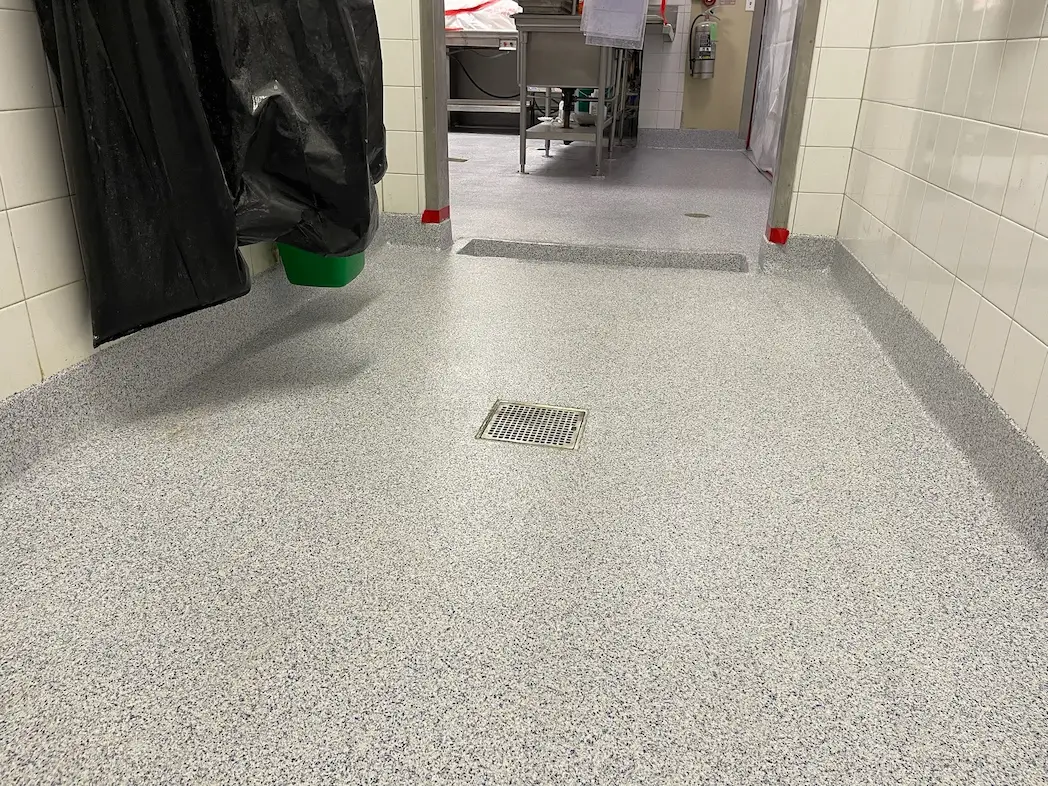
Full-broadcast quartz and decorative flake systems create a more uniform texture across the floor surface. A full layer of quartz aggregate is embedded into the epoxy base coat, producing consistent, durable traction that holds up well under traffic and repeated cleaning. These systems are particularly well-suited to wet areas, commercial kitchens, locker rooms, and facilities where both slip resistance and a professional finish are required. Quartz systems also tend to perform better in environments where sanitation requirements are strict, because the texture is more uniform and easier to manage hygienically than coarse spot-broadcast aggregate.
Slip-Resistant Topcoats Over an Existing Floor
Where the underlying floor is structurally sound and the existing coating is adhering well, a slip-resistant topcoat can upgrade traction without a full system rebuild. This is often the most cost-effective path for facilities that need to address a specific safety concern in one zone without taking the whole floor down. Surface preparation is still required; a topcoat applied over a poorly prepped surface will delaminate under traffic regardless of how good the aggregate is.
Textured Topcoats for Zone-Specific Risk
Not every area in a facility needs the same level of texture. Entry vestibules, manufacturing aisles, ramps, and washdown areas each carry different slip risks. Mild aggregate works in lighter-duty, drier areas. More aggressive texture is appropriate where floors stay wet, where oils and fats are present, or where workers are moving quickly in waterproof boots. Zone-specific specification avoids the common mistake of over-engineering low-risk areas and under-specifying high-risk ones.
Matching the System to Each Zone in Your Facility
The same coating profile is not appropriate for every area in a facility. Below is a practical reference for matching slip-resistant epoxy floor coatings to the actual conditions in common industrial and commercial environments.
| Zone | Primary Hazard | Recommended System |
|---|---|---|
| Dry warehouse aisles | Dust, powder, dry spills | Lightly textured epoxy or broadcast flake |
| Manufacturing walkways | Oils, coolants, particulate | Medium aggregate; broadcast quartz in higher-risk areas |
| Wet entries / locker rooms | Standing water, tracked moisture | Full-broadcast quartz or flake; anti-slip topcoat |
| Food and beverage washdown areas | Water, fats, cleaning chemicals | Broadcast quartz or urethane cement for severe environments |
| Ramps and sloped paths | Any of the above, amplified by grade | More aggressive aggregate; urethane cement where thermal shock or hot-water exposure applies |
| Barefoot areas | Water | Finer texture to balance grip and comfort |
| Forklift and wheeled traffic zones | Wear, abrasion, impact | System selection driven by traffic load and traction need combined |
Specify by zone, not by building
The practical lesson here is to specify by zone, not by building. A single system applied across an entire facility will be under-specified in high-risk areas and unnecessarily aggressive in low-risk ones.
The Tradeoff Between Texture and Cleanability
One of the most important considerations in slip-resistant epoxy flooring is the relationship between traction and sanitation. More texture means more grip. It also means more surface area where contamination can collect, and more difficulty achieving a thorough clean.
In food processing, pharmaceutical manufacturing, and healthcare environments, this tradeoff is not theoretical. The floor must provide enough traction to be safe without becoming a hygiene liability. A surface that cannot be cleaned to a certified standard is not a better floor, even if it grips well.
The right system balances these requirements. A fine quartz broadcast is often appropriate in a food production area that requires frequent washdowns, because it provides meaningful traction without creating the deep surface valleys that harbor bacteria and resist cleaning. A coarser profile may be appropriate in a loading dock or mechanical room where sanitation standards are less stringent and slip risk is higher.
Contractors who understand both the traction requirement and the cleaning protocol can specify a system that satisfies both without compromising either.
What OSHA Requires, and What It Does Not
OSHA's standard for walking-working surfaces, 29 CFR 1910.22, requires that floor surfaces be kept clean, orderly, and sanitary. Where wet processes are used, the standard calls for adequate drainage and dry-standing areas or appropriate footwear. Hazardous conditions must be corrected or guarded before employees return to the surface.
What the standard does not require is a specific coefficient of friction value. OSHA has not mandated a numerical friction threshold for walking-working surfaces. Claims referencing an "OSHA-rated" slip resistance level or an "OSHA-compliant COF" have no regulatory basis. Compliance is achieved by maintaining safe walking-working conditions, not by hitting a friction number.
This distinction matters when evaluating product claims. A coating marketed as OSHA-compliant based on a COF value is using language that sounds authoritative but is not grounded in the actual standard. The right question is not what friction score the product achieves, but whether the system is appropriately specified for the actual hazard conditions in each zone of your facility.
When Epoxy Is Not the Right Answer
Epoxy performs well across a broad range of commercial and industrial applications. It is not, however, the right base system for every environment. The following conditions typically exceed what standard epoxy is designed to handle, regardless of what aggregate or topcoat is applied:
- ›Constant standing water or a substrate with chronic moisture vapor transmission
- ›Steam cleaning or hot-water washdowns above epoxy's thermal tolerance (typically above 140 to 150 degrees Fahrenheit)
- ›Rapid temperature cycling between cold processing zones and heated washdown areas
- ›Aggressive caustic cleaning agents used in heavy sanitation programs
- ›Meat, dairy, or beverage production areas where floors stay persistently wet and cleaning chemistry is harsh
Why urethane cement may be the better base
In these environments, urethane cement is the more appropriate base system. It bonds directly to concrete, tolerates thermal shock, produces a seamless non-porous surface, and holds up under daily abuse that would cause standard epoxy to delaminate. Urethane cement systems can also be specified with appropriate texture profiles for slip resistance in any of these conditions.
Specifying the wrong base system is one of the most common reasons floor coatings fail prematurely. Adding aggregate to an epoxy topcoat does not correct a resin system that is not suited to the operating environment.
Recoat or Rebuild: How to Make the Right Call
Slip-resistant upgrades through a topcoat work best when the underlying floor is structurally sound. If the substrate shows cracking, delamination, or moisture damage, a slip-resistant topcoat addresses the surface condition but does nothing for the underlying problem. The surface will look improved temporarily, then fail again in the same locations.
When Recoating Is Appropriate
- ›The floor is structurally intact and the primary issue is inadequate traction
- ›The existing coating is adhering well with no widespread delamination
- ›Surface preparation can be completed to achieve proper adhesion
- ›The base system is suited to the current operating conditions
When Rebuilding Is the Right Move
- ›There is cracking, heaving, or bond failure across significant areas
- ›Moisture vapor transmission is compromising adhesion
- ›The same area has been patched and failed more than once in a 12-month window
- ›The existing system is not suited to the current environment, regardless of surface condition
Specify for the Floor, Not for the Facility
Surface preparation is not optional in either case. Slip-resistant coatings require proper concrete profile and clean adhesion to perform as specified. A slip-resistant topcoat applied to a poorly prepped or failing substrate is not a safety improvement; it is a delay.
Slip-resistant epoxy flooring is not a product you select from a catalog and apply uniformly across a building. It is a system that has to be matched to the specific hazards, contaminants, traffic patterns, and cleaning requirements of each zone in your facility. Getting that match right reduces incident risk, extends coating life, and keeps you out of the compliance conversations you would rather not have.
The question to start with is not "Is epoxy non-slip?" It is "What does each zone in this facility actually need?" The answer to that question drives every specification decision that follows.
Peckham Coatings has been specifying and installing industrial floor systems for over a century. Our work spans food and beverage, pharmaceutical, aerospace, warehousing, and manufacturing facilities. We install textured epoxy, broadcast quartz and flake systems, anti-slip finishes, and urethane cement systems where standard epoxy is not suited to the environment.
Contact us to schedule a flooring safety assessment. We will evaluate your zones, contaminants, and traffic patterns and recommend the right system for each area.
Related Peckham services
FAQ
Can epoxy flooring be non-slip?
Yes, with the right system design. Epoxy on its own carries no built-in slip rating. Standard smooth epoxy can be slippery when wet. A properly specified system with aggregate broadcast into the topcoat, a full-broadcast quartz or flake layer, or a slip-resistant topcoat product significantly reduces slip risk in most industrial and commercial environments.
Does more texture mean a harder floor to clean?
Yes, generally. Coarser aggregate increases traction but also increases surface area where contamination collects and makes thorough cleaning more difficult. In regulated environments such as food processing or pharmaceutical production, the texture profile needs to be calibrated so that the floor provides adequate grip without creating a surface that cannot be cleaned to the required standard.
Does OSHA require a specific slip resistance rating for floors?
No. OSHA's 29 CFR 1910.22 requires that walking-working surfaces be maintained in a clean, dry (where feasible), and hazard-free condition. The standard does not mandate a specific coefficient of friction value. Claims referencing an OSHA-rated slip resistance level have no regulatory basis.
When should I choose urethane cement instead of epoxy?
Urethane cement is the better choice when the floor faces hot-water washdowns, thermal shock, aggressive sanitation chemicals, or constant moisture exposure. These are conditions where standard epoxy systems are prone to delamination regardless of the aggregate used. Urethane cement can also be specified with appropriate texture for slip resistance in these demanding environments.
Can slip resistance be added to an existing epoxy floor?
Yes, if the existing floor is structurally sound and the coating is adhering well. A slip-resistant topcoat can be applied with proper surface preparation. If there is delamination, cracking, or moisture damage, those underlying issues need to be addressed before any upgrade will hold.
What is the best slip-resistant epoxy floor coating for warehouse environments?
For most warehouse environments with dry to occasionally wet aisles, a lightly to moderately textured epoxy with aggregate broadcast into the topcoat works well. In areas with more frequent moisture, oils, or heavy forklift traffic, a broadcast quartz system provides better and more consistent traction. Ramps and dock areas typically warrant more aggressive texture or a urethane cement system where wet conditions are persistent.
How long does slip-resistant epoxy flooring last?
A well-specified and properly installed system typically lasts five to ten years in light commercial use and three to seven years in heavy industrial environments. The textured surface can wear in high-traffic areas over time, so periodic inspection and maintenance coats are part of the long-term performance plan.