How long does epoxy flooring actually last?
A properly installed epoxy floor lasts 3 to 20+ years depending on the system, the environment, and — more than anything — how the concrete was prepped before the first coat went down. A dry warehouse running a 20-mil thin-film system is a completely different animal than a 1/4″ urethane cement floor in a meat plant, and lumping them into a single lifespan number is where most online answers go wrong.
Over 25 years and thousands of installs across the Western U.S., we've walked back onto floors we poured in 2007 that still look factory-new, and we've been called in to tear out $3.50/sf floors that failed in 14 months. The difference is almost never the resin brand on the bucket — it's the match between the system spec and what the floor actually has to survive day to day. The table below is what we tell owners to plan for, by environment, based on field data from our own portfolio.
| Environment | Typical system | Expected lifespan | Dominant failure mode |
|---|---|---|---|
| Retail / showroom | 40–60 mil self-leveling epoxy | 10 – 15 years | Point-load scratches, cleaner-chemistry etching |
| Warehouse (light forklift) | 20–40 mil high-build epoxy | 7 – 12 years | Wheel abrasion in aisles, joint edge chipping |
| Manufacturing / assembly | 60–100 mil quartz broadcast | 10 – 15 years | Impact spalling, oil intrusion at machine bases |
| Aircraft hangar | 80–100 mil chemical-resistant epoxy | 12 – 18 years | Jet-A / Skydrol softening if wrong topcoat spec'd |
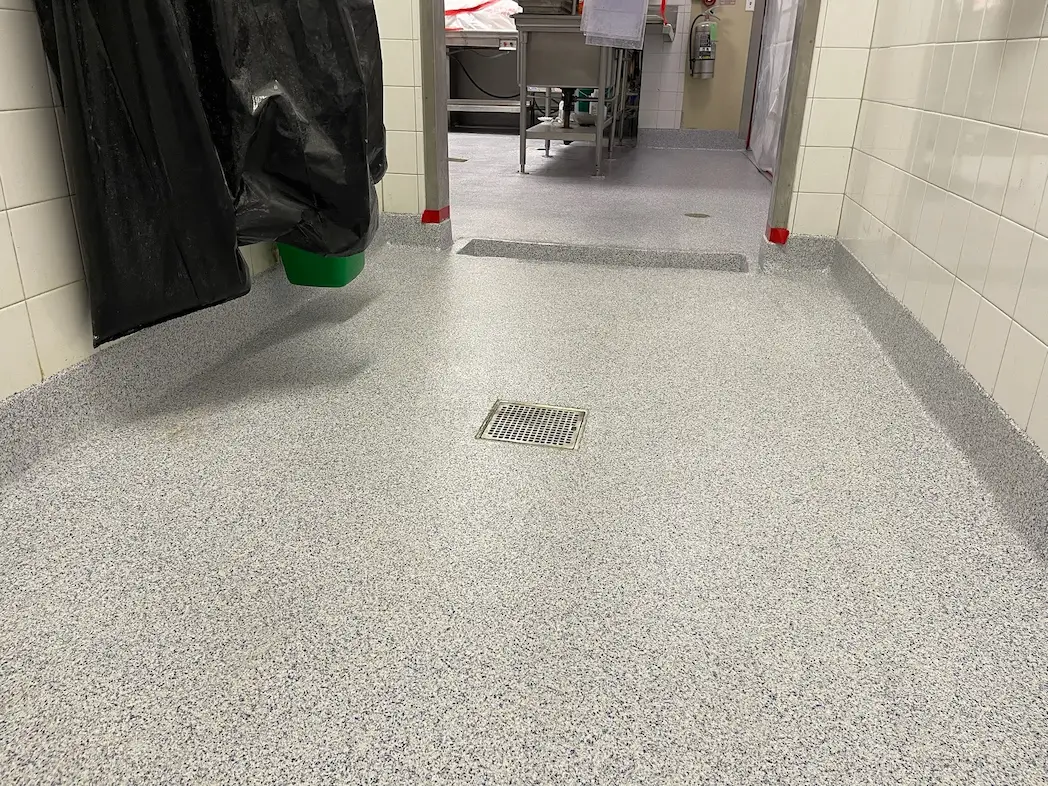
| Commercial kitchen (wash-down) | 3/16″ urethane cement slurry | 12 – 20 years | Grout-line wear, drain-transition failure |
| Dairy / brewery / meat plant | 1/4″+ urethane cement trowel-down | 15 – 20+ years | Almost none if coving and drains detailed correctly |
| Pharma / cleanroom | 100–125 mil ESD or novolac epoxy | 10 – 15 years | Static-drain failure, aggressive CIP chemistry |
What actually kills an epoxy floor
Epoxy doesn't die of old age. It fails from a specific mechanism that a walk-through and a moisture test could have flagged before day one. Five failure modes account for well over 90% of the epoxy repairs we're called in to handle.
1. Moisture vapor drive from below
The #1 killer of otherwise-good epoxy floors. Concrete is porous, and any slab-on-grade without a working vapor barrier will push moisture up into the coating. When vapor pressure exceeds the coating's tolerance (typically 5 lb / 80% RH for standard epoxy), you get osmotic blisters — quarter-sized bubbles that pop and take chunks of coating with them. This can start inside six months on a slab that never got a calcium-chloride or RH test.
2. Thermal shock
Epoxy expands roughly 3× as fast as concrete when heated. Hit a 45°F floor with a 180°F sanitation rinse and the coating shears at the bond line. This is why every serious food-and-beverage plant runs urethane cement instead of epoxy — the CTE nearly matches concrete, so it survives the thermal cycle that would crack an epoxy floor in two seasons.
3. UV exposure
Standard aromatic epoxy ambers and chalks under UV. Near a south-facing overhead door or a bank of skylights, you'll see visible yellowing on the sun stripe inside 12–18 months. The fix is an aliphatic urethane or polyaspartic topcoat, which is UV-stable. It costs another $0.75–$1.50/sf but is non-negotiable for anywhere sunlight reaches the floor.
4. Mechanical abrasion
Steel-wheel pallet jacks, hard-plastic caster carts, and steel-tracked equipment cut through thin-film epoxy in months. The fix isn't a stronger resin — it's more thickness. A 20-mil floor in a hand-jack aisle is a maintenance program in disguise; a 60-mil quartz broadcast in the same aisle lasts 10+ years.
5. Chemical attack
Standard epoxy tolerates dilute alkalis and most sanitizers, but breaks down under concentrated acids, strong solvents, and animal fats over time. Novolac epoxy and vinyl ester topcoats handle aggressive chemistry, but they need to be specified up front — swapping topcoats after the fact means a full recoat.
Epoxy floors after 5 years: what's normal vs what's a defect
"Epoxy floors after 5 years" is one of the most-searched phrases we see — usually from an owner staring at a floor that doesn't look like it did on day one and trying to decide if it's failing. Here's the honest breakdown of what's cosmetic aging vs what's actually a warranty claim.
Normal at year 5
Slight sheen loss in the highest-traffic lanes. Minor scratches visible under raking light. Some cleaner-chemistry etching around drains. Faint yellowing on aromatic topcoats where sunlight lands. Grout lines slightly worn on quartz broadcast systems. None of this is failure — this is a coating doing its job of being the sacrificial layer above the concrete.
Not normal at year 5
Delamination — coating lifting off the concrete in sheets or discs. Osmotic blistering — quarter-sized bubbles that weren't there year one. Coating chipping at joints and cracks that were never detailed. Any exposed concrete larger than a coin. Any of these is an installation defect (bad prep, missed moisture test, wrong system) and warrants a call to the original contractor before the failure spreads.
The recoat window
Most epoxy floors benefit from a topcoat refresh at year 6–8, well before the base coats start showing wear. A screen-and-recoat runs 30–50% of a new floor and resets the clock for another 5–8 years. Miss the window and you're looking at a full re-blast and reinstall — 3× the cost of the maintenance recoat.
System-type comparison: lifespan and best environment
The lifespan of "epoxy flooring" swings by a factor of 5 depending on the system class. If you're comparing bids or specifying a new floor, this is the table to reference.
| System | Thickness | Realistic lifespan | Best environment | Wrong environment |
|---|---|---|---|---|
| Thin-film (2-coat) | 10–20 mil | 3 – 6 years | Dry storage, light foot traffic | Forklift aisles, washdown, sun exposure |
| High-build epoxy | 20–40 mil | 6 – 10 years | Warehouse, light manufacturing | Hot washdown, thermal cycling |
| Flake / quartz broadcast | 60–125 mil | 10 – 18 years | Retail, kitchens, showrooms, auto dealerships | Concentrated acids without novolac topcoat |
| Epoxy mortar | 1/4″+ | 10 – 15 years | Heavy impact, chemical duty | Wet-slab conditions without primer |
| Urethane cement | 3/16″ – 1/2″ | 15 – 20+ years | Dairy, brewery, meat plant, cook-chill | Overkill in dry, climate-controlled spaces |
The 6 install variables that swing lifespan by 5+ years
Two floors with the same resin brand on the bucket can differ by a decade in service life based on how they were installed. These are the six variables our estimators walk every project against.
- ›Surface profile — CSP-3 diamond grind for thin-film, CSP-4/5 shotblast for high-build. Wrong profile = delamination inside 24 months.
- ›Moisture testing — every slab over 10 years old gets calcium chloride or RH probe before spec is finalized. Skipping this is the single most common cause of premature failure.
- ›Coat thickness verified wet — not "three coats" but a mil-gauge check between coats. Under-built floors wear through years early.
- ›Cure temperature and humidity window — most epoxies need 55–85°F substrate temp and dew-point separation above 5°F. Pouring outside the window causes amine blush and topcoat adhesion loss.
- ›Topcoat chemistry matched to service — aliphatic urethane or polyaspartic for UV, novolac for aggressive chemistry, satin polyaspartic for cleanability.
- ›Joint and crack detailing — every control joint honored, every structural crack routed and filled. Undetailed joints telegraph through and become the first failure line.
How to extend the life of an existing epoxy floor
Whether you inherited a floor or you're heading toward year 5 on one you installed, the highest-leverage moves aren't chemistry — they're maintenance discipline. Our shorter overview of epoxy floor lifespan answers the same question at a system level.
- ›Auto-scrub with a neutral pH cleaner, not caustic degreasers. Alkaline cleaners over 11 pH strip topcoat gloss and shorten life.
- ›Address spills same-shift. Battery acid, brake fluid, and concentrated cleaners left overnight etch even chemical-resistant systems.
- ›Add walk-off mats at every entry — grit tracked in is the #1 driver of scratch density.
- ›Recoat topcoat at year 6–8 before base coats show wear. A $1.50–$3.00/sf refresh resets service life.
- ›Repair chips and gouges within 30 days — moisture and cleaner get under the coating fast at any exposed concrete.
- ›Skip pressure-washing thin-film floors — the water jet finds every weak bond line.
FAQ
Will an epoxy floor really last 20 years?
In the right environment, yes. Urethane cement floors in dairies, breweries, and meat plants routinely run 15–20+ years with only topcoat refreshes. Standard epoxy in a dry warehouse lasts 7–12 years. Thin-film epoxy in a high-abrasion forklift lane can be down to bare concrete in 2–3 years. The lifespan number is meaningless without the system and environment attached to it.
What should an epoxy floor look like after 5 years?
Sheen loss in traffic lanes, minor scratches, and slight cleaner etching are normal — that's the topcoat doing its job. Delamination, blistering, or exposed concrete larger than a coin at year 5 is an install defect, not aging, and should be inspected before the failure spreads.
Can you extend the life of an existing epoxy floor?
Yes — a topcoat screen-and-recoat at year 6–8 resets service life for another 5–8 years and costs 30–50% of a new floor. Waiting until the base coats show wear turns a maintenance recoat into a full re-blast and reinstall at 3× the cost.
Is epoxy or urethane cement better for a commercial kitchen?
Urethane cement, without exception, if the kitchen does hot washdown. Epoxy in a wash-down kitchen typically fails inside 3 years due to thermal shock at the CIP or rinse cycle. Urethane cement in the same space runs 12–20 years. Cold-line prep or dry retail food service can use a high-build quartz epoxy.
Does epoxy floor lifespan depend on the resin brand?
Much less than most owners think. All major industrial resin manufacturers meet the same ASTM performance thresholds. What differentiates a 20-year floor from a 3-year floor is the surface prep, moisture mitigation, coat thickness, and topcoat match — the installer's discipline, not the label on the bucket.