A hangar floor solves two problems most flooring never has to solve together. It has to resist jet fuel, hydraulic fluid, and de-icing chemicals that degrade standard resins fast — and it has to do it across a floor plate that can run 30,000 to 100,000+ square feet without a cold joint breaking up the surface. Aerospace flooring gets treated like an industrial warehouse spec more often than it should, and that's usually where hangar floors start failing within the first few years.
The chemical exposure is what sets hangars apart. Skydrol and other phosphate-ester hydraulic fluids attack standard epoxy resin on contact, softening and eventually stripping coatings that hold up fine against oils and solvents everywhere else. Jet-A fuel spills, de-icing fluid tracked in from the ramp, and cleaning chemicals used on aircraft add to a chemical load that a typical warehouse floor spec was never built for.
This guide covers what actually fails in hangar environments, which systems hold up, how large-format installation works at that scale, and what fire classification means for the floor spec.
Why Hangar Floors Fail: Jet Fuel, Hydraulic Fluid, and Point Loads
Standard epoxy and even some novolac systems degrade under sustained Skydrol exposure — the phosphate-ester chemistry breaks down resin bonds that hold up fine against petroleum-based fluids. A floor spec'd for general aerospace flooring solutions without accounting for hydraulic fluid exposure looks fine on day one and starts softening at the maintenance bay within a year or two.
Point loads are the other failure driver. Aircraft jacks, tow bars, and maintenance stands concentrate enormous weight on small contact areas, which a thin-film system can't distribute without cracking through to the substrate. The floor needs enough build thickness to spread that load before it reaches the concrete.
Chemical-Resistant Systems for Hangar Environments
Novolac epoxy topcoats are the standard answer for hydraulic fluid and fuel exposure — the novolac resin chemistry holds up against phosphate esters and aromatic hydrocarbons in a way standard bisphenol-A epoxy doesn't. For zones with heavy Skydrol exposure, such as active maintenance bays, a novolac system is generally non-negotiable rather than optional.
Where fast return-to-service matters — a hangar that can't take an aircraft out of rotation for days — MMA systems offer cure times measured in hours rather than days, at a materials cost premium that's often justified by the value of the aircraft sitting idle.
Large-Format Installation: Joints, Pours, and Seamless Coverage at Scale
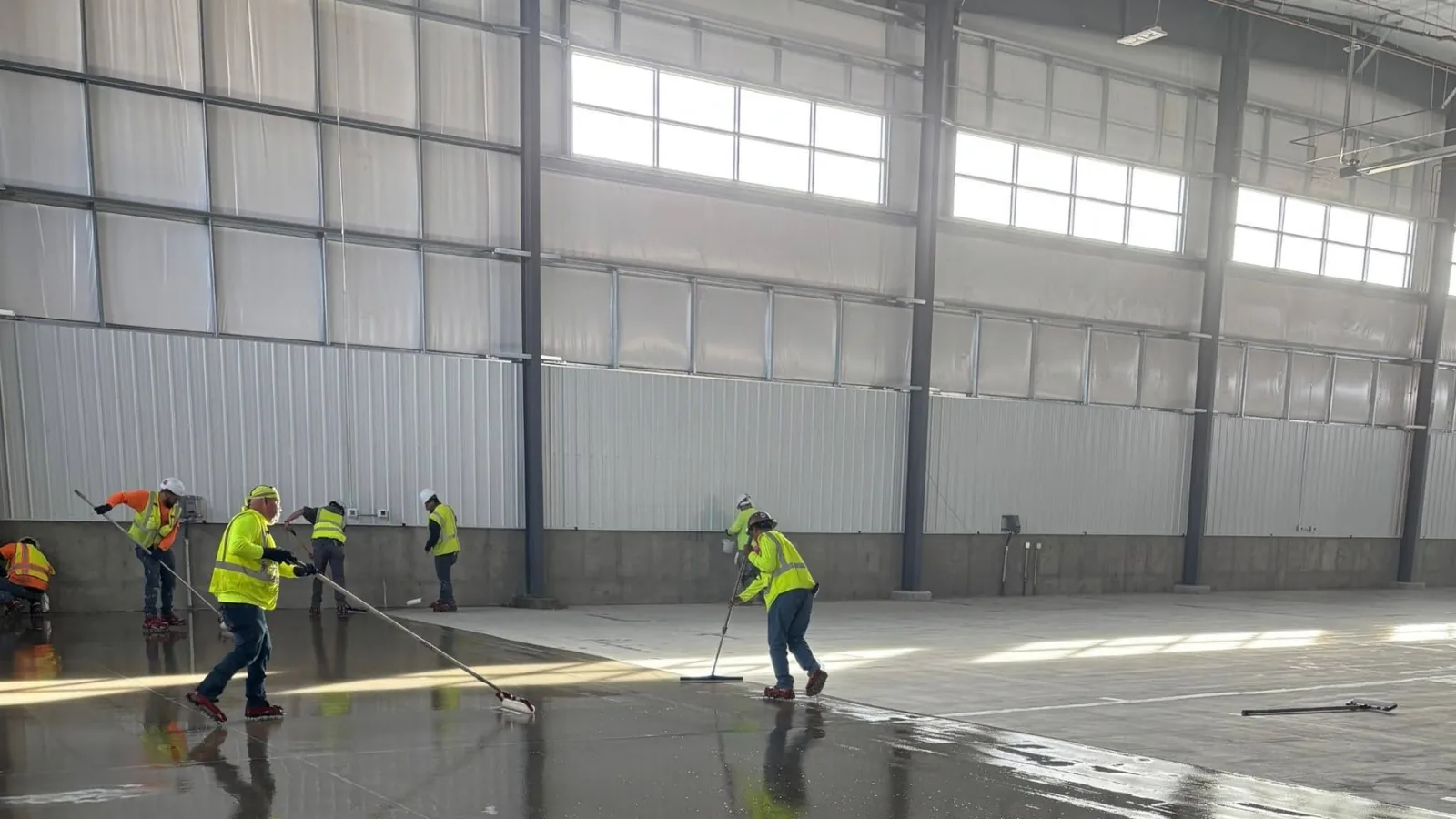
A hangar floor's size is itself a technical challenge. Coordinating a pour across tens of thousands of square feet means managing control joints, expansion joints, and construction joints so the finished surface reads as one continuous system rather than a patchwork of sections with visible seams and differential wear.
Joint detailing matters more here than in a smaller facility, because a poorly detailed joint under heavy aircraft loading becomes a failure point that propagates outward. Every joint gets routed, backer-rodged, and filled with a flexible sealant rated for the traffic it will see, rather than left as a bare saw cut.
Fire Classification and Floor Coatings: What NFPA 409 Means for Your Spec
Hangar construction and fire protection are governed by NFPA 409, the National Fire Protection Association's standard for aircraft hangars, which classifies hangars into groups based on door height and fire area and sets requirements accordingly. The floor coating itself isn't the primary fire-protection element — that's the sprinkler and suppression system — but coating chemistry and any secondary containment detailing should be coordinated with the facility's NFPA 409 classification rather than specified in isolation.
Scheduling Around Flight Operations
A hangar rarely goes fully idle for a floor project. Work gets sequenced by bay or by zone, so aircraft can be relocated to an unaffected section rather than grounding the whole operation. Ventilation planning matters more here than in most industrial settings, since a large enclosed volume with limited airflow needs active ventilation during application and cure.
Solve the Chemistry and the Scale Together
Hangar flooring is a chemical-resistance problem and a large-format installation problem at the same time, and a spec that only solves one of them fails at the other. Getting both right means matching resin chemistry to the actual fluids the floor will see and planning the pour and joint layout for a floor plate that size from the start.
Peckham Coatings installs chemical-resistant epoxy and MMA systems for hangars and aerospace facilities across the Western U.S., sequenced around active flight operations. Get in touch to talk through your hangar's chemical exposure and scheduling constraints.
FAQ
What flooring resists Skydrol and hydraulic fluid best?
Novolac epoxy topcoats generally offer the best resistance to phosphate-ester hydraulic fluids like Skydrol. Standard epoxy softens and degrades under sustained exposure; novolac chemistry holds up significantly better.
How thick does a hangar floor coating need to be?
It depends on the loads involved, but maintenance bays handling aircraft jacks and heavy equipment typically need a high-build or mortar system rather than a thin-film coating, to distribute point loads before they reach the substrate.
Can a hangar floor be installed without grounding all aircraft?
Usually, yes, with the work sequenced by bay or zone so unaffected aircraft can be relocated rather than the entire hangar going offline at once.
Does hangar flooring need to meet NFPA 409?
NFPA 409 governs the hangar's fire classification and protection systems generally rather than the floor coating specifically, but the floor spec should be coordinated with the facility's classification and any secondary containment requirements.