Most facility types have one flooring problem. A college campus has several, all managed by the same facilities department and the same maintenance budget. College flooring has to cover a dining hall, a chemistry lab, a gym locker room, and a dorm lobby, each with a different exposure profile, and it usually all has to get done in the same narrow window between semesters.
That combination is what makes campus flooring different from a typical commercial portfolio. A facilities director specifying flooring for higher education isn't solving one problem repeated across several buildings; they're solving four or five distinct problems that happen to share a purchase order and an installation calendar built around when students are actually gone.
This guide covers what to specify for the building types that come up most on a campus, and how to plan installation around an academic calendar that doesn't leave much room to improvise.
Why Campus Flooring Is a Multi-Building Problem, Not One Spec
A facilities team managing epoxy flooring for a school or university is really managing several flooring categories at once: food service, laboratory, athletic, and general-traffic common areas. Treating all of it as one spec — usually whichever system was used last — tends to underperform in at least one building type, because a system built for a dorm lobby doesn't hold up in a chemistry lab, and vice versa.
Budget cycles make this worse if it isn't planned for. Bundling several building types into one project under one flooring standard is efficient for procurement, but only if the standard actually fits each building's exposure. Otherwise, the campus ends up with a lab floor that wears out early or a lobby floor that cost more than it needed to.
Dining Halls and Student Unions: Commercial-Grade Flooring for Food Service
Campus dining facilities function like any other commercial food service operation, grease, water, and heavy foot traffic during service hours, followed by a hard cleaning cycle. Seamless epoxy or urethane systems built for food service hold up here the same way they would in any commercial kitchen, with the added consideration that these spaces often need to look presentable in adjoining dining areas, not just perform well in the back of house.
Slip resistance matters as much here as durability. Traffic through a dining hall combines wet floors, trays, and students moving quickly between classes, which raises the stakes on a system that meets a wet dynamic coefficient of friction of 0.42 or higher in the standard's terms.
Science and Research Labs: Chemical-Resistant Systems on Campus
Teaching and research labs introduce a chemical exposure most other campus buildings never see: solvents, acids, and reagents that a standard epoxy floor isn't built to withstand indefinitely.
Lab flooring needs the same chemical-resistant specification as an industrial facility handling similar chemistry, not a general-purpose campus standard.
Static control is a secondary concern in some lab types, particularly in electronics, physics, or engineering programs working with sensitive equipment, where the flooring may need to support the same static-dissipative properties used in industrial ESD-protected areas.
Athletic Facilities and Locker Rooms: Moisture and Slip Resistance
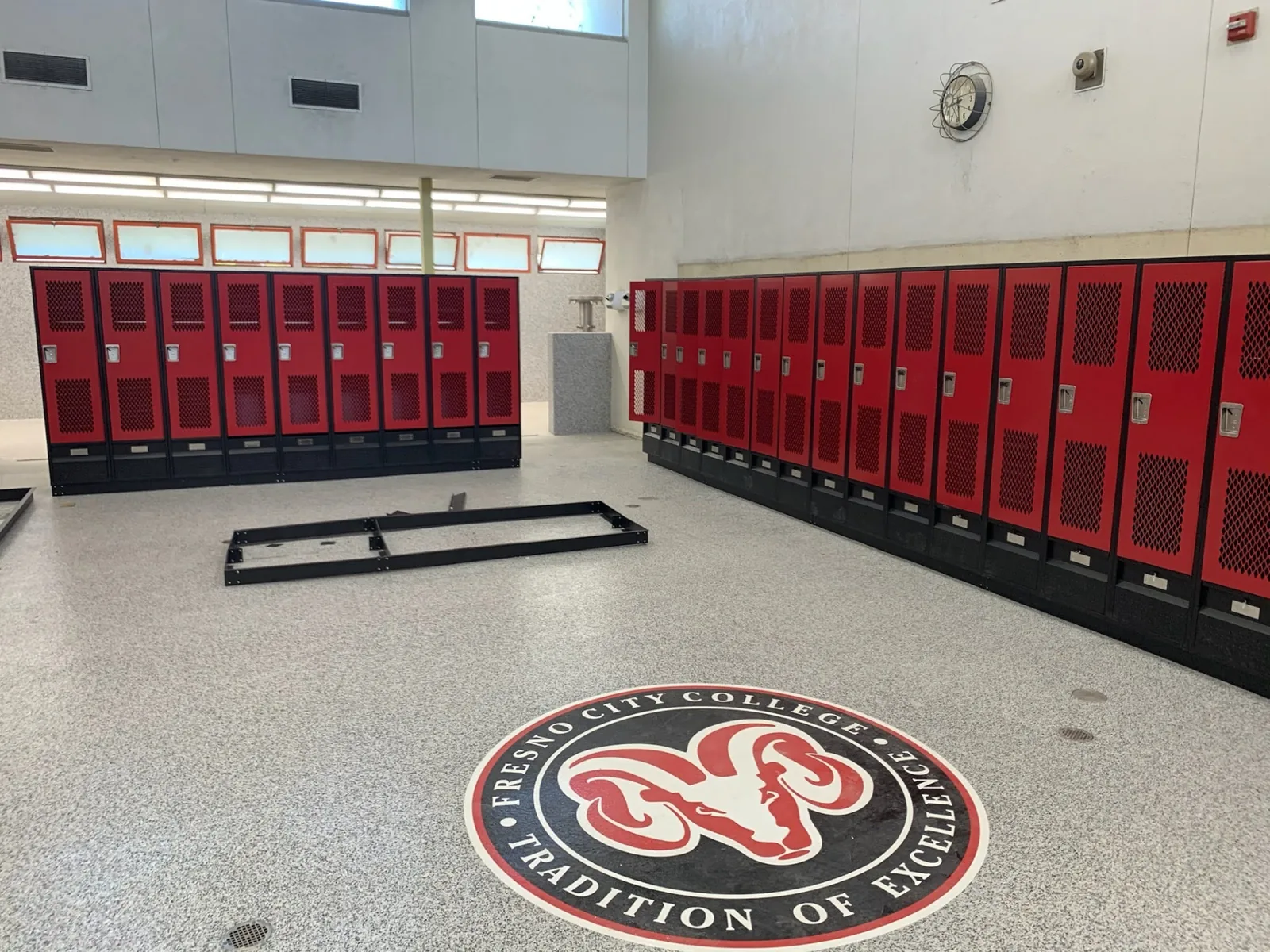
Locker rooms, pool decks, and athletic training facilities combine constant moisture with bare feet, which raises the bar on both slip resistance and antimicrobial performance compared to a standard campus building. A system that looks fine when dry can become a liability the moment it's wet, which is the normal operating condition in these spaces.
Coved base and integrated drainage matter here for the same reason they matter in a commercial kitchen or a healthcare facility: standing water and organic buildup in the corners where floor meets wall is where these floors actually fail, not in the open field.
Scheduling Around the Academic Calendar
A campus doesn't have a slow season the way a retail facility might. It has specific windows: winter break, spring break, and the stretch between spring and fall semesters. Flooring projects that can't be finished and fully cured within one of those windows either run into the next semester or get pushed to the following break entirely.
Cure time is the constraint that gets underestimated most often. A system that needs 48 to 72 hours before it can handle foot traffic has to be sequenced so the last work day still leaves enough buffer before students return, not scheduled right up against the calendar's edge.
Match Each Building to Its Own Spec
A college campus isn't one flooring project, it's several, each with a different exposure profile, sharing a maintenance budget and an installation calendar dictated by the academic year. Specifying dining, lab, athletic, and general-traffic spaces to their own actual requirements, rather than one campus-wide standard, is what keeps each building performing for its full expected life instead of the weakest one failing early.
Peckham Coatings installs flooring systems across school and university campuses in the Western U.S., specified building-by-building and scheduled around the academic calendar. Get in touch to talk through your campus's building mix and break-window timeline.
FAQ
What flooring is best for a college dining hall?
Seamless epoxy or urethane systems built for food service hold up best, the same as they would in any commercial kitchen — with slip resistance rated for a wet, high-traffic dining environment.
Do campus science labs need special flooring?
Yes. Teaching and research labs need chemical-resistant flooring rated for the solvents, acids, and reagents used in that specific lab, rather than the general-purpose flooring standard used elsewhere on campus.
Can flooring renovations be done while school is in session?
It's possible for small, contained areas, but most campus flooring projects are scheduled during winter, spring, or summer breaks specifically because cure time and disruption are easier to manage when the building isn't in active use.
What's the most durable flooring for high-traffic campus buildings?
For general common areas, high-build epoxy or urethane systems hold up well under sustained foot traffic. For specialty spaces — labs, athletic facilities, dining — the right system depends on that building's specific exposure rather than one universal answer.