Why tank coatings are specified by tank type, not by one universal product
There is no single 'tank coating.' A crude oil storage tank, a chemical process vessel, and an aboveground steel water tank all corrode for different reasons, and the coating that protects one can fail quickly in another. Specifying by tank type — what the tank holds, what the surface is made of, and whether the coating sits in immersion or in the weather — is what keeps a lining on the wall.
Three questions drive almost every industrial tank coating decision: what is the service (immersion, vapor space, or exterior atmospheric), what is the substrate (steel or concrete), and what is the outage window. Get those three right and the shortlist of workable systems is usually short. Get them wrong and no amount of mil thickness saves the job.
This guide walks through the common industrial and chemical storage tank categories and what changes between them. It is a specification-side overview, not a product sheet — the exact system always comes back to the chemistry, temperature, and condition of your specific tank.
Crude oil storage tanks: interior immersion vs. exterior atmospheric
Crude tanks are really two coating projects wearing one tank number. The interior and the exterior see completely different exposure, and they are almost never coated with the same system.
Tank bottoms and lower shell (immersion service)
The interior bottom and lower shell sit in product and in the water that drops out of it. That bottom water layer — not the hydrocarbon above it — is what drives most interior corrosion, because it carries chlorides, sulfur species, and whatever else came along with the crude. Interior linings for this zone are chosen for immersion resistance and holiday-free continuity: a pinhole in an immersion lining is a corrosion cell, not a cosmetic defect.
That is why interior tank linings get holiday testing and film-thickness verification as a normal part of the work, and why surface preparation standards are tighter inside the tank than outside it.
Vapor space and underside of the roof
The vapor space above the liquid level is often the most aggressive part of the tank. Condensation cycles on the underside of the roof and the upper shell, combining moisture with whatever vapors the product gives off. Coatings selected only for liquid immersion sometimes underperform here, which is why vapor-space exposure is called out separately in a good spec rather than assumed to match the bottom.
Exterior shell and roof (atmospheric service)
The outside of the tank is an atmospheric corrosion problem: UV, rain, temperature cycling, and — near coastlines or process areas — airborne salts and chemicals. Exterior systems are built around adhesion to prepared steel and long-term weathering, and they can usually be applied without taking the tank out of service, which makes exterior work far easier to schedule than an interior lining.
Steel tanks: corrosion, preparation, and adhesion
On steel, the coating is only as good as the blast underneath it. Mill scale, flash rust, and residual soluble salts are the three things that quietly wreck otherwise correct specifications. A steel tank lining spec should name the preparation standard — commonly a near-white blast such as SSPC-SP10 for immersion service — and should say how the surface will be kept clean between blasting and coating.
Two details matter more on tanks than on flat industrial surfaces. First, edges and welds: sharp weld toes, undercut, and weld spatter hold thin film and become the first failure points, so they are ground and stripe-coated before the full film goes on. Second, pitted steel: existing pitting has to be assessed and addressed before coating, because a lining bridged over a deep pit will eventually fail into it.
Access and containment are part of the job as well. Blasting a tank exterior means containment for the abrasive and the removed coating; blasting an interior means confined-space entry, ventilation, and lighting. Those requirements affect schedule and cost as much as the material choice does.
- ›Specify the preparation standard, not just the product
- ›Grind and stripe-coat welds, edges, and bolt heads before the full coat
- ›Address existing pitting rather than coating over it
- ›Plan containment, ventilation, and confined-space entry with the coating scope
Chemical and fuel process tanks: chemistry drives the lining
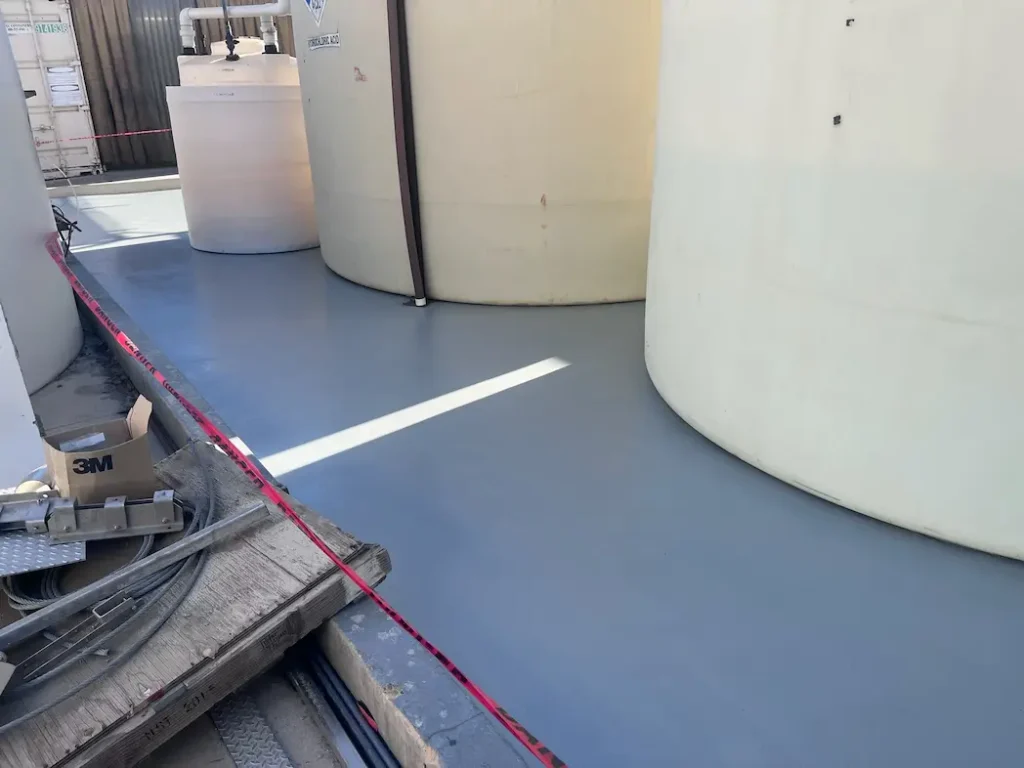
For chemical and fuel service, the deciding factor is the stored chemistry — concentration and temperature included. The same acid at ambient temperature and at elevated temperature can call for two different lining families, and a lining that handles a chemical in splash contact may not hold up to continuous immersion in it.
Practically, that means a lining recommendation for a process tank should never be made from the tank drawing alone. What is needed is the product being stored, its concentration, the maximum operating temperature, whether the tank is cleaned with anything aggressive, and how long the vessel can be out of service. Cleaning chemistry catches people out regularly — a lining sized for the product can be attacked by the caustic wash used between batches.
Peckham Coatings installs high-build epoxy and polyurethane lining and coating systems for industrial tanks and vessels, and specifies them against the actual service conditions rather than a generic product tier. If you want the broader picture of how our industrial systems fit together, the industrial coatings overview covers the full range.
Concrete vs. steel substrates
Concrete tanks and steel tanks fail differently, and their coatings are prepared differently. Steel needs a blast profile and protection from flash rust. Concrete needs an open, sound surface — typically achieved by abrasive blasting or hydroblasting to a specified concrete surface profile — plus repair of spalls and honeycombing, and verification that moisture in the slab or wall is within the manufacturer's limits before anything is applied.
Concrete also brings joints and penetrations that need detailing. Cold joints, construction joints, pipe penetrations, and anchor points are the places linings leak first, and they are usually detail-coated and reinforced ahead of the main application.
Where a concrete containment structure is involved rather than a vessel, the requirement shifts again — see secondary containment coatings for that side of the work.
Tank farms and secondary containment belong in the same scope
A tank rarely stands alone. Dikes, curbs, sumps, and transfer areas around it are part of the same containment picture, and they see spills, UV, and thermal cycling on top of routine traffic. Coating a tank interior while leaving cracked containment concrete underneath it solves half the problem.
Bundling containment work with tank work also tends to be the more efficient sequence: the same mobilization, the same containment setup, and one shutdown instead of two. When you are putting an RFQ together, the industrial coating spec and RFQ checklist is a useful frame for describing scope in a way contractors can bid consistently.
How industrial tank coatings differ from wastewater tank linings
Wastewater tanks are a related but genuinely different problem. There, the primary attacker is microbially induced corrosion — sulfide-reducing bacteria converting H2S into sulfuric acid on the wall above the waterline — rather than a stored product chemistry. That changes what the lining has to resist and where in the tank the worst exposure sits.
If your project is a clarifier, digester, lift station, or headworks rather than a storage or process tank, that content is the better starting point.
FAQ
What is the difference between a tank coating and a tank lining?
In common usage, a lining is the interior system that contacts the stored product, and a coating is the exterior system that handles weather and atmospheric corrosion. Interior linings carry stricter preparation, thickness, and holiday-testing requirements because a single defect creates a corrosion cell.
Why does the inside of a crude oil tank corrode if it's full of oil?
Because water settles out of the product and collects at the bottom, carrying chlorides and sulfur species with it. That bottom water layer, along with condensation in the vapor space above the liquid, drives most interior tank corrosion.
Can a tank exterior be coated without taking the tank out of service?
Exterior atmospheric work can often be done while the tank stays in service, subject to site safety and containment requirements. Interior lining work requires the tank to be emptied, cleaned, and entered as a confined space, so it has to be scheduled around an outage.
What information do you need to recommend a tank lining?
The substrate (steel or concrete), what the tank holds and at what concentration and temperature, whether the exposure is immersion or vapor space, the current condition of the surface, any cleaning chemistry used, and the length of the available outage window.